My experience of mentoring

I have been asked a few times recently to give presentations on my experience of mentoring as an early career researcher. I have been lucky to have had a number of formal and informal mentoring experiences over the last 10 years, and some have been more successful than others.

Business Idea, Planning, Business Plan

I’ve been mentored by bosses, colleagues and friends of friends. One of the most influential arrangements has been the HSRAANZ mentoring scheme, which I’ve participated in twice: first as a PhD student who was close to finishing but didn’t know what to do next, and more recently as an early career researcher wondering how to become a mid-career researcher. In both cases I was paired with a senior health economist in a different organisation and different area of health economics to myself, but both were very experienced academics with valuable advice.

Being mentored as a PhD student. I had taken a number of sideways steps into health economics, so didn’t feel like I was on a clear career path. In particular, my main interest was oncology, but everyone around me seemed to specialise in a methodology rather than a clinical area and I wasn’t sure what I should do next. I sent my CV to my mentor and we had a long and broad discussion of my options and the various opportunities available to me. He asked about my wishlist for the next 5 years and, having heard it, suggested that to get everything on it I should probably look overseas. I’m so glad he did, because I got my dream postdoctoral fellowship in the health economics of cancer at the National Cancer Registry in Ireland. My mentor and I only had that one (long) conversation, but it changed my life!

Being mentored as a postdoc. I reapplied for a mentor through HSRAANZ half way through my second postdoc. I was wondering how to move from being an early career researcher ‘with potential’ to being a mid-career research with demonstrated value. This relationship was structured differently, with a series of wide ranging chats over monthly coffee meetings. I found it really helpful to get a fresh perspective on what being a mid-career researcher looked like, and types of roles and responsibilities I should be aiming for. It was also great to have another set of eyes looking out for opportunities that might be valuable, and to introduce me to a wider network.

As part of my postdoc I also get mentoring with two (very) senior UTS academics. Although they are from outside my field, they are excellent at explaining the politics of the university system and academia more generally. They have given me a fresh perspective on strategic career planning and how to package my research for impact and a more general audience.

Most helpful aspects of being mentored: In both the HSRAANZ mentoring scheme and my other mentoring experiences, being able to talk to someone about the big picture has been invaluable. In particular, talking to someone outside my organisation, so they weren’t constrained to what else was happening in the office (e.g. what projects are coming up, the development needs of other people, etc.). Hearing how things work in different organisations was also great, as I’ve had limited exposure to different academic environments. And finally, having another set of yes to look out for opportunities for me, but also to be able to review grant application, look for gaps in my CV and give me fresh feedback has been fabulous.

Top tips to make the most of being mentored:

  1. Push your mentor to make sure meetings happen. In almost all my mentoring experiences I’ve had to be proactive. My mentors are senior academics, which means they are busy. So be organised – set meeting times with calendar invites, organise a room/cafe/teleconference line, send an agenda prior to the meeting, etc.
  2. Use your CV as a starting point for the first meeting. Send an updated CV to your mentor at least a week before the meeting and ask them to review it. Then use the meeting time to go over it and get feedback on the strengths and weaknesses they perceive, and how they would see you as a job applicant. Then as they get to know you they can give advice on how to adjust your CV to reflect your true skills and knowledge, and also be on the look out for opportunities to fill in gaps or show off your strengths.
  3. Be honest, so that you can get the most out of them. Although it is easy to fall into the trap of trying to impress them, you actually want them to give you advice for the real you – even if that means you’re unorganised, un-confident and/or unsure what you’re doing.
  4. Have a defined question you want to work through with them. Even if it is a big one (what should I do after my PhD!) this gives structure to the relationship, and also helps you identify when you’ve achieved your goal.

Being mentored has given me a broader perspective, a wider network of contacts and access to different resources and opportunities. I will continue to seek mentoring throughout my career, and am delighted to have the opportunity to now be a mentor to an early career researcher through the HSRAANZ scheme.


Mentoring resources

The reality of chemotherapy side effects

My latest publication shows that over three-quarters of people having chemotherapy in New South Wales experience multiple side effects during their treatment, and for over 60% of people this included a serious side effect. These results confirm previous research that suggests side effects might be more common, and more serious, in clinical practice (ie ‘real life’) than reported in clinical trials.

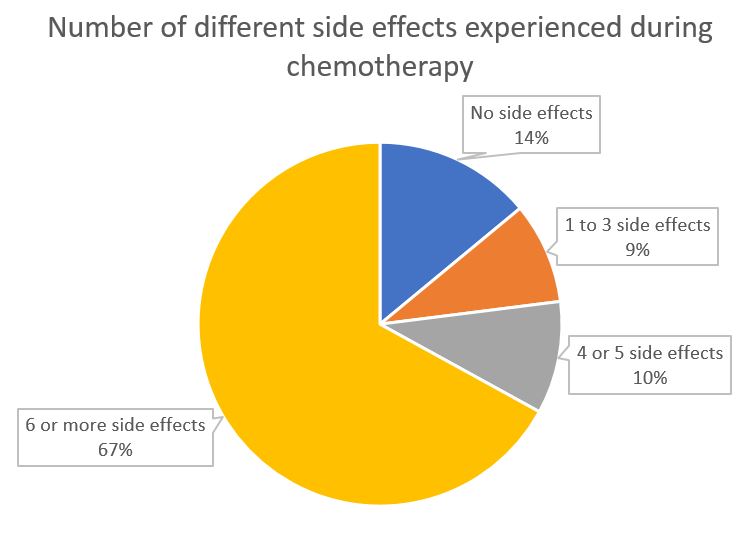
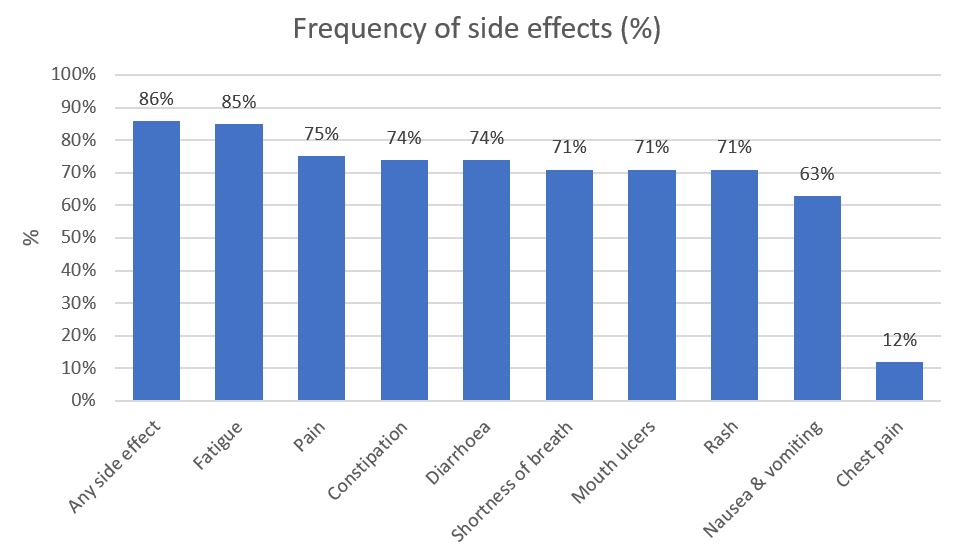
During their chemotherapy, 86% of our sample (who had lung, breast or colorectal cancer) reported at least one side effect, and 67% experienced six or more different side effects. Fatigue was the most common side effect (80%), followed by pain (75%), constipation (74%), and diarrhoea (74%). For nearly a quarter of participants (24%) the side effects were mild, but for many more (62%) the side effects were moderate or severe.

The number of different side effects experienced during chemotherapy
The number of different self-reported side effects experienced during chemotherapy by participants with lung, breast or colorectal cancer in the EOCC study

Older people in our sample were less likely to have a side effect. This is perhaps because older people tend to receive less aggressive treatments, despite this also possibly reducing how effective their chemotherapy is. Other things, like the type and stage of cancer, gender, education, and socioeconomic status did not change how likely a person was to have a side effect.

When we looked at the patterns of side effects over time, many people had mild side effects which stayed with them throughout their chemotherapy, especially constipation, diarrhoea, mucositis and nausea / vomiting. There was also a particularly large proportion of people reporting serious fatigue throughout their treatment.

The frequency of side effects
The frequency of side effects self-reported side effects experienced during chemotherapy by participants with lung, breast or colorectal cancer in the EOCC study

The first study of this type in Australia, our Elements of Cancer Care study followed 441 people with breast, lung and colorectal cancer having chemotherapy in New South Wales. We interviewed them each month during their chemotherapy treatment to ask them about a wide range of topics, including what side effects they’d experienced and how serious they were. We also collected information from their medical records at the hospital and with Medicare.

Side effects in real life vs clinical trials

When new chemotherapy treatments are developed, the side effects they cause are tested in research studies called clinical trials. Doctors, patients and policy makers then base their decisions about chemotherapy on the data from these clinical trials.

But, what happens in clinical trials does not always reflect what happens in real life. Clinical trials usually have very strict criteria for who can participate. Clinical trial participants are usually younger and fitter than typical cancer patients, and so be more able to cope physically with chemotherapy and therefore less likely to have a side effect. In addition, clinical trials are usually conducted in large, high-quality, teaching hospitals with extra monitoring and treatment of side effects, which may reduce how often they occur, or how serious they become.

Asking patients about side effects

How patients are asked about side effects can also influence what they report. When doctors or nurses ask general questions like “how have you been feeling” or “have you had any side effects” patients might not remember or report all of their side effects, particularly if they are not still happening. We gave participants a checklist of side effects, which may have encouraged them to report a greater variety of side effects, and those side effects which were less severe. This is a technique which could be implemented by doctors and nurses in cancer care clinics.

What does this mean?

On top of dealing with a diagnosis of cancer and being treated with chemotherapy, having side effects can affect someone’s physical health, survival, quality of life and emotional state. Because our information comes from real life, rather than clinical trials, it allows doctors, nurses, policy makers and patients to think more realistically about the side effects of chemotherapy.


Full reference (Open Access): Pearce A, Haas M, Viney R, Pearson SA, Haywood P, Brown C, Ward R (2017). Incidence and severity of self-reported chemotherapy side effects in routine care: A prospective cohort study. PLOS One 12(10): e0184360

The Elements of Cancer Care study was funded by the National Health and Medical Research Council (Health Services Research Grant ID 455366). Alison was supported by a University of Technology Sydney Doctoral Scholarship, and a PhD top-up scholarship from NHMRC Health Services Research Grant (ID455366). Sallie is supported by a Cancer Institute NSW Career Development Fellowship (ID: 12/CDF/2-25). No funding organisation had any role in the study design, data collection and analysis, decision to publish or preparation of the manuscript.

Getting started with social media to promote your research

Imagine a newspaper where you get to choose the sections to include (front page, finance, politics, entertainment, sport etc), and also who writes the articles in each section…  Welcome to twitter…

Is twitter a social media fad for tween girls to share their love of Justin Bieber, or is it a social media tool that can no longer be ignored?  Twitter is now used by health officials to track disease outbreaks, and monitored for security threats in the US.  Worldwide, 21% of internet users actively use twitter each month, and over 55’s are the fastest growing demographic on twitter. So how can academics use it to promote themselves and their research?

First of all, what is twitter?  You create a profile of who you are, and then you ‘follow’ people to see what they say.  By following people who tweet about topics you’re interested in you get a twitter feed filled with information, links, news and updates tailored for you. 

For 50% of twitter users, this is all they do.  But to get the most out of twitter, you need to interact.  You can retweet things you find interesting, as well as creating your own tweets.  Tweets can be about things you hear at conferences, get by email or simply your own thoughts (see hints below on writing good tweets). You now have a global network of people who are interested in the same things you are.

For example, my profile says I’m a health economics PhD student examining costs of cancer care.  I follow organisations like ISPORorg, CHEyork, simplystats, Healtheconall and NCImedia, and people who tweet about health economics, writing and being a PhD student, like Inger Mewburn (thesiswhisperer), James Hayton (3monththesis) and Arthur Phillips (MPH_adapt). 

So why are many academics nervous about getting involved in twitter?  It seems to me to be a combination of misconceptions about the benefits available, and a fear of losing control.

Much of the public perception of twitter is that it is photos of what people ate for breakfast and the inane thoughts of music superstars.  But I conceptualise twitter as my personal newspaper.  I choose if I want to include a food section or an entertainment section in my health economics newspaper.  And if I do want some of these sections, I chose how big they are and who writes the stories that get published.  In addition, twitter also allows me to publish news that forms the content of other people’s newspapers.  And it is this aspect that can get my name, and my research, known internationally. 

The perception that academics will lose control of their content is an interesting one.  Some are worried that unpublished work, such as that presented at conferences, should not be tweeted.  But a conference is a public event, so a presenter wouldn’t present their work if they didn’t want it heard.  My perspective is that while you do potentially lose some control of who hears your message and when and where and how, the benefits of having your work seen by a potentially much larger, more diverse audience than would be in a conference session far outweighs these potential downsides.

Tips for using twitter to promote your research

  • Use your real name
  • Tweet a 70:30 mixture of professional and general interest/personal information
  • Use hashtags when you tweet , and to find people to follow
  • Be active and engaged, but  remember that you don’t have to be ‘on’ all the time
  • Everything you tweet is public and forever
  • Don’t use all 140 characters (to allow others to retweet)
  • Follow the conventions for acknowledging sources of your information
  • If something is said in public, it can be tweeted. But it might sometimes be nice to ask permission first (or let people know you’re ok with it if it is you presenting).
  • For an excellent guide to getting started with Twitter, check out the Mashable guidebook

The most re-tweeted image of all time (817,000 retweets & 300,000  favourites) 


Resources for Emerging Researchers

This blog post was originally written for and published by the Health Services Research Association of Australia and New Zealand (HSRAANZ) Emerging Researcher Group (ERGO) section of the December 2012 Newsletter. It has been, and will continue to be, updated as I find out about new resources.


The number of resources for PhD students and emerging researchers available on the internet has increased exponentially in recent years.  To assist in discovering those which can be the most helpful in navigating the difficult and often confusing (but very rewarding) path to an academic career, the ERGO group (with the assistance of the PhD Group at CHERE) has put together a list of online resources.  The list is aimed at early career researchers, including PhD students, but many of the resources listed may be of interest to anyone working in health services research.

Websites / blogs

Following the blogs of people in your field can expose you to the latest research, as well as upcoming conferences, funding opportunities.  There are also a number of websites and blogs aimed specifically at PhD students and early career researchers, often with a focus on writing.

Name Summary Web / Twitter
Incidental Economist “Contemplating health care with a focus on research, an eye on reform” http://theincidentaleconomist.com/
@IncidentalEcon
Thesis Whisperer “newspaper style blog dedicated to helping research students” http://thesiswhisperer.com/
@thesiswhisperer
Healthecon-all Subscription email list which distributes messages to the international health economics community.  Set up in 1995 it has 1300 members https://www.jiscmail.ac.uk/cgi-bin/webadmin?A0=HEALTHECON-ALL
@healtheconall
Academic HE Blog UK-centric blog for news, analysis and developments in health economics http://aheblog.com/
@aheblog
PHTwitter Journal Club ‘Meets’ fortnightly to discuss selected public health related academic papers http://phtwitjc.wordpress.com/
@PHTwitJC
Simply stats 3 biostats profs post interesting ideas, article links and advice for new statisticians. http://simplystatistics.org/
@simplystats
3-month thesis “uncommon guide to thesis writing & phd life” http://3monththesis.com/
@3monththesis
AcWriMo Academic Writing Month – set a writing goal, make it public, work on it in Nov 2012 #AcWriMo


Twitter feeds are another good way of staying in touch with people and organizations who work in a similar area.

  • Health economics – @ScHARR – HEDS; @HERC_Oxford; #healtheconomics;
  • PhD students / early career researchers – @PhD2Published; @hildabast; #PhDchat; #Ecrchat;


Organisations to join

The following organizations have opportunities or resources specifically for early career researchers and/or PhD students

Name Early career researcher specific activities and resources Web / Twitter
HSRAANZ
  • Discounted student membership prices and conference registration
  • Special interest group for emerging researchers (ERGO)
  • ERGO facebook page with sharing of information, resources and opportunities
  • Mentoring program
  • ERGO specific activities at bi-annual conference (including ERGO dinner and ERGO lunchtime session)
  • ERGO seminars and workshops
  • Job opportunities advertised through mailing list
  • PhD Student prize
www.hsraanz.org
ISPOR
  • Discounted student membership prices and conference registration
  • Research tools repository
  • Many educational opportunities (although not specific to ECR)
  • Job opportunities listing
http://www.ispor.org/
iHEA
  • Discounted student membership prices and conference registration
  • PhD scholarships for conference attendance
https://www.healtheconomics.org/
AHES
  • PhD scholarships for annual conference
http://www.ahes.org.au/
ISOQOL
  • New Investigators Special Interest Group
  • New Investigators Blog
http://newinvestigators-isoqol.blogspot.ie/

iPhone / iPad apps

These apps will all make your student / research life easier!

Name Summary
Dropbox To access all your docs from any computer, and this can include your EndNote library.  There is a special promotion at the moment if you have a student/uni email address you get an extra 3Gb storage
Endnote for iPad Access your EndNote library on the go. You will need to set up an EndNote web account, but then your articles, including PDF’s will be available anywhere, anytime.
GoodNotes To review/revise documents
EverNote For taking notes
TeamViewer To access your computer remotely
Toodledo To do list
Pomodoro Timers
  • Pomodoro Time Management Lite by rapidrabbit
  • Simple Pomodoro Timer from SourcePad
  • 30/30  – a more flexible version – you can set various time limits for a list of tasks, and it will tell you when to move on to the next one
  • http://mytomatoes.com/  –  a free online timer for desktop based pomodoros

Feedback?

Do you have an iPad app you couldn’t live without, or a blog that you really enjoy?  We would love to keep expanding and updating this list of resources, so please let us know if you have other resources that you find useful as an early career researcher.

My experience of working with data that isn’t ‘mine’

This blog post was originally written for and published by the Health Services Research Association of Australia and New Zealand (HSRAANZ) Emerging Researcher Group (ERGO) section of the August 2012 Newsletter.


During my PhD I was lucky enough to be offered access to a large dataset for analysis.  This was a fantastic opportunity, which has strengthened my PhD and my data management and analysis skills.  Logistically however, it was not always easy.  I learnt a number of lessons that I thought other early career researchers may find useful.

There were four main issues I encountered:

Physically accessing the data

The data was held at another institution, who had received ethics approval and access to the data on the basis that it was kept confidential and did not leave their secure building.  I therefore needed to go to their site to conduct the analysis.  Whilst this was not foreseen to be an issue, there was a huge amount of red tape to get access to the university building, a desk, a computer, a log-in etc, because I was neither a staff member nor a student at that university.

To avoid these issues, start planning logistics early, and be realistic about what you need.  ‘Hot desking’ is not as easy as it sounds, so if you need your own computer, or a larger than average hard drive, be specific.  Make sure you ask very specific questions very early on about how you will access buildings and resources such as stationary and software etc.

Working with data that wasn’t ‘mine’

It takes extra time to get to know your data when you haven’t been involved in collecting it.  A data dictionary can be extremely helpful in these situations, and it is worth continuing to ask for one, if it is not provided with your data.  The other issue with working with data that isn’t yours, is that you may end up waiting for other people to prepare or clean datasets before you can use them.  Obviously this impacts on timelines, so build in a generous buffer into your project plans.

Working with a very large dataset

My working data file was over 60Gb, and analysis code often took days to run.  The computer system at the University was not really configured to cope with work being done overnight, and so often my programs would get interrupted by virus scans and automated backups.  I ended up using a local drive and doing my own backups, to avoid the issue, but in future I would try to sort this out before starting.

Working off site

Finally, I have already covered some of the access issues of working off site, but the other issues this raised was that it was quite isolating.  There was no one there who was really responsible for my work or who understood my project and methods, and I couldn’t sit down and show my data to anyone at my PhD office.  It was also difficult to integrate time to be in two offices into my daily schedule.  Meetings and events often prevented me going for days at a time, by which time I had forgotten what I was working on!  The solution to this was to get as organized as possible, to keep detailed notes of what I did each day, and to use tools such as dropbox (where allowed) to keep track of things.