Moving my health economics teaching online during COVID19

HPOL5000 is a core unit in the Master of Public Health program at the University of Sydney. Anne Marie Thow and I co-coordinate the unit, which covers introductory health policy and health economics.

Semester 1 2020 started on the 17th of February and we were excited to have a large cohort of nearly 300 students. The unit runs with two concurrent modes of study:

  • online (remote) learning, where students watch online lecture material, access reading material online and then participate in asynchronous tutorial activities via discussion boards, or
  • block mode (face-to-face) learning, where students access reading materials and some pre-recorded lectures online, but also attend two full day workshops of lectures and activities, and 6 x 1.5 hour face-to-face tutorial groups.

The first few weeks of semester went well, with great participation in online introductory activities, and the first face-to-face workshop day for block mode students running smoothly. We had a small cohort of international students who couldn’t travel to Australia to start the semester due to COVID19, so we set up some special online (asynchronous) tutorial groups for them to attend in the meantime.

In week 3 we were advised to prepare, just in case teaching needed to move online. In week 4 this was confirmed – due to COVID19 pandemic restrictions all teaching activities must now be online. This gave us one week to move the 2nd workshop day (held in week 5, and focussed on health economics content) online, as well as work out how to manage the rest of the semester.

Overall, I think the 2nd workshop ran well online, although it was a lot of work to set up. I learned a lot that I will use to improve future workshops, whether they are held online or face to face (or a combination) and thought it might be worth documenting what I did and how it worked.

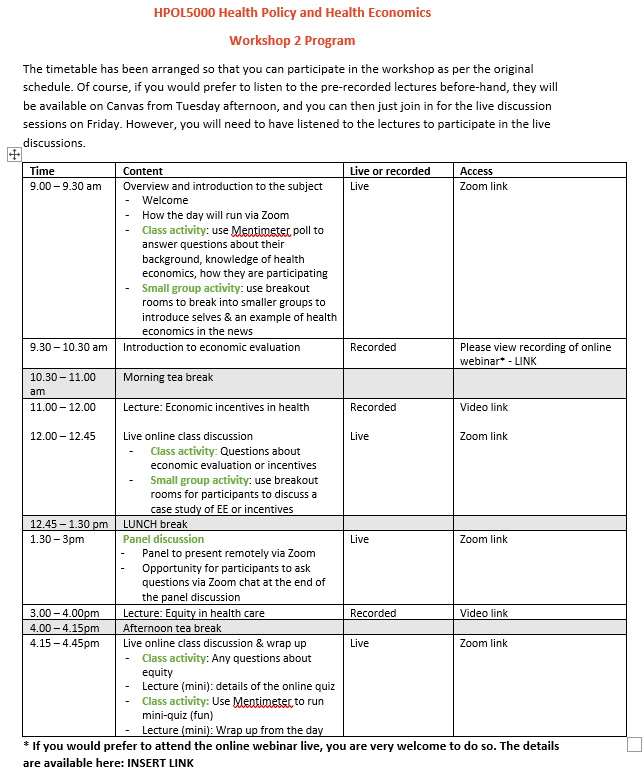
We decided to run the workshop on the day it was scheduled, but with some tweaks for online delivery. We arranged a mixture of pre-recorded lectures and interactive Zoom sessions, and scheduled them all in a timetable similar to what students would have followed for the face to face workshop (see timetable at bottom of post).

The day started with a live Zoom meeting to introduce myself, the material and how the day would run. I used Mentimeter to do some quick polls and word cloud activities to find out a bit more about the students who were participating.
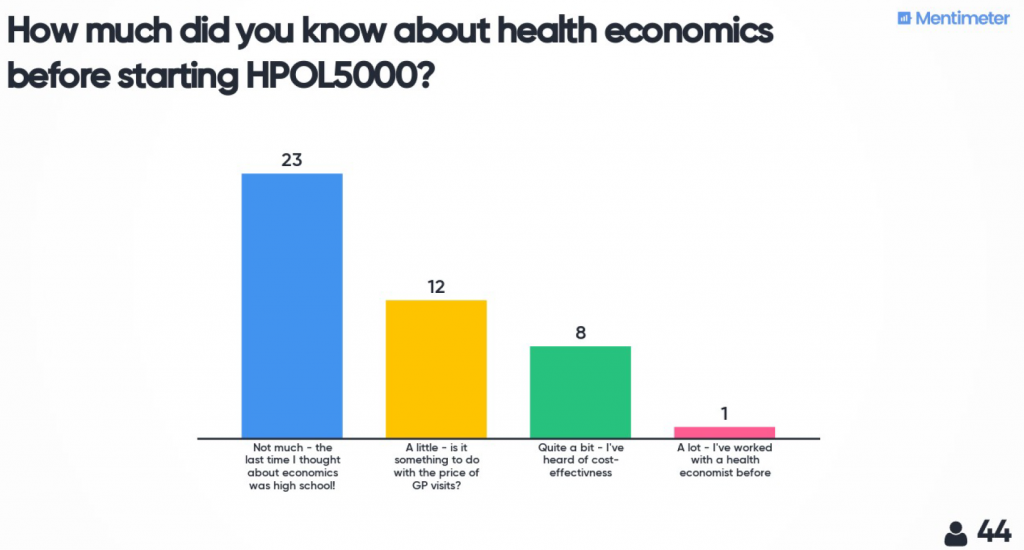
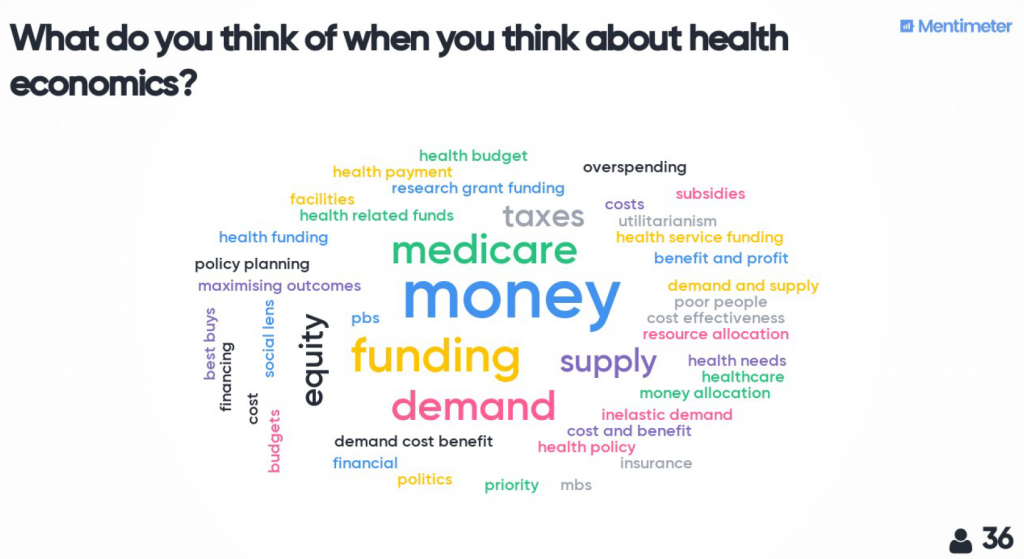
The three planned lectures were pre-recorded and uploaded for students to access a week before the workshop. This allowed students to choose if they wanted to do the full workshop day as programmed, or access the lectures in the week before and just attend the live sessions on the day.  Using pre-recorded lectures instead of doing them all live also gave me time on the workshop day to prepare for (and recover from) the more interactive sessions during the day.

Each lecture was allocated a time during the day when students could go off and watch it (if they hadn’t already) and then a zoom meeting was held afterwards for discussion, questions and some interactive activities. For the interactive activities I used Mentimeter tasks as well as Zoom breakout rooms to encourage student interactions with each other. One of these sessions worked well and one didn’t – being more organised to make sure students had access to the material for the small group discussion outside of Zoom would have been really helpful (I ended up telling students to take a screenshot/photo on their camera of the exercise on the screen so they could refer to it in the groups!)

We also had a panel discussion session. When run in the face-to-face workshop this is usually very popular with students, and I was really pleased with how it ran online. We used a meetin

g rather than a webinar Zoom meeting and this worked fine. As with the rest of the day the students were really helpful with their cameras and microphones etc, and we had good interaction via the chat function with people asking questions.
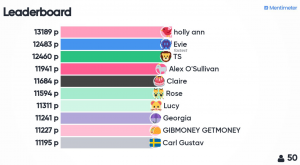
In the last interactive session of the day I used a Mentimeter quiz to check concept understanding. I had feedback that this was one of the best bits of the day. There were 5 questions about each of the 3 main topics we had covered, and the questions were designed to be relatively easy, but students only had 10 seconds to answer each one. A leader board was shown at the end of each set of 5 questions to generate a feeling of competition, and it was simple to set up.

Student feedback:

We had a lot of positive feedback about the workshop. A quick evaluation (done via Mentimeter) at the end of the day showed the Panel Discussion session and Quiz were both very popular. When asked one thing they found confusing or unclear, many people mentioned that Zoom was unstable sometimes, and in particular the breakout room activities were rushed. So next time I will allow much more time for those, and make sure I have a second person on hand to help manage the logistics. Overall the comments were positive, and made the whole experience worthwhile. Some examples:

  • “It was actually a really effective alternative to a face to face day. The timetable with spaced out live webinars kept me on track with time”
  • “The panel was really great to see the concepts we’ve gone through in the lectures and readings from a professional perspective. I’ve really enjoyed the health economics side of this course more than anticipated so thank you for this lovely teaching”
  • “The panel discussion… the experts we had onboard really enriched and contributed to the learning process”
  • “Quiz time is really useful to review”
  • “Being able to snack the entire time while listening to everyone!”

Overall, using a mixture of tools and activities was helpful to keep students (and myself!) interested and engaged. A whole day of Zoom was a lot, and I think multi-day workshops would need to be extra diligent about giving appropriate breaks, making pre-recorded material available beforehand, and mixing up the type of interaction. For a large group like this having a second person online to help with coordination and admin would be great. But, I would absolutely run a workshop like this again in the future, although hopefully with more than a week to prepare!

My top tips:

Zoom:

  • I am still not sure whether using one zoom meeting for the whole day (which is what I did) is better than setting up a separate zoom meeting for each interactive session. Different meetings would allow different settings for each session (e.g. a webinar for the panel discussion), but also means students need to log into the right room at the right time.
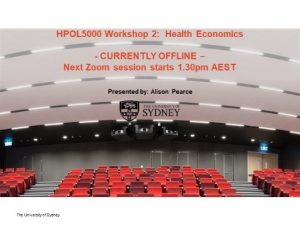
  • I made a slide to display on the screen in between sessions, which was helpful.
  • I wish I’d recorded every session to share with students who couldn’t join on the day. I now know that you can record multiple sections of a Zoom meeting and each downloads as a separate file.
  • I made sure I had a clear place nominated on Canvas and mentioned first thing in the morning where students should go for information if something went wrong with the technology during the day (e.g. I’ll post here [LINK] on Canvas, and I’ll send an announcement)!

Break out rooms:

  • Using the random allocation setting was easy and meant students mixed
  • They take time for students to join and introduce themselves, so allow extra time
  • Need to ensure students know what they need to do and can still access materials while in the breakout room – either pre-send slides or use Mentimeter
  • It would have been great to have a second ‘admin’ person who could manage the logistics of putting people in rooms so I could circulate through the rooms contributing to the discussion, more like the face to face setting.
  • Err on the side of having slightly larger groups than you think, because some students sign in and then turn of camera & mic and don’t participate. Suggest 4 as the minimum (likely then to get at least 2) and up to 6 or 7 still works ok.

Chat function:

  • It’s difficult to monitor while you’re presenting, but…
  • I’ve seen some really nice examples of students using it amongst themselves to share links and clarify content during a lecture.

Mentimeter:

  • Was a great way to get engagement from a large class – much more flexible than ‘raising hands’ in class or polls within Zoom
  • The quiz with the leaderboard was fun! The only problem was not being able to give away small prizes (e.g. chocolate frogs etc) that would usually happen in a face-to-face setting. I’ve been trying to think creatively about what might replace this – perhaps the winner gets a link to my favourite health economics GIF?!

Security:

  • I didn’t have any problems with security or inappropriate behaviour, although in one lecture I’ve given subsequently a student started sharing their screen of them playing a computer game during one of the breaks. But, I now add a password to most zoom meetings by default, and for any larger group meetings I think I would always try to have an administrative person online who could handle stuff like that while I’m teaching.


Timetable
Disseminating my research

Publication in a peer-reviewed journal is no longer sufficient – research findings need to be disseminated more broadly to ensure (and demonstrate) that they have impact. This means that once I’ve submitted an article for publication I immediately start working on the dissemination plan (if I haven’t already done it as a form of ‘productive procrastination‘!)

There is no one-size-fits-all approach. However, I do have a standard list of dissemination options and a general process that I use. Here it is, in case it is useful for you:

Step 1: Write different versions of your article (during article writing/immediately after submission)

  • Blog post – I usually start by writing a blog post, and this is an excellent article about how to turn your journal article into a blog post, but I’ve also found this one useful.
  • Press release – The University press office has been really helpful in structuring the story and using appropriate language for my press releases in the past (although they sometimes need help making sure the essential message isn’t lost).
  • Talking pointstalking points are a great way to prepare for a media interview. In addition, the process of identifying and refining my talking points helps to identify and refine the message, audience and purpose for my dissemination strategy. I usually come up with about 5 talking points, for example: a short sentence and a short paragraph about the main result(s), a short sentence and a short paragraph about the implications, and a short sentence about what might come next.

Step 2: Circulate your pitch (before acceptance)

You may need to modify your pitch for each of the sources below, but you can base all of them on your press release. You need to circulate your pitch to these sources before your article is accepted, because often things move quite quickly after acceptance and you want to have time to work with these people to craft the best piece, and to coordinate the release dates with them.

  • Send a pitch to The Conversation (to do this you need to log in, and use the link on the left hand side of the dashboard)
  • Send a pitch to podcasts that might be interested. Podcasts usually have a longer lead time than the general media, so better to contact them early. There are some health-specific ones (e.g. 2SER Think:Health, the Research Roundup podcast by PC4) or more general ones, such as the University of Sydney podcast ‘Open for Discussion‘.
  • Send a pitch to any other magazine, website, etc that might be relevant. For example, in the past I’ve published summaries in Cancer Professional and have flagged oncologynews.com.au and Croakey as a possible media to approach in the future.

Step 3: Prepare for release (once accepted)

Once you know your article is accepted you should get a timeline for when it will be released. At this point you should let anyone who you’ve worked with on an article (e.g. the Conversation, etc) know the date and coordinate the release. You can also:

  • Contact relevant journalists with your press release. The press office can do this for you, and/or you can use informal approaches such as twitter (list of tweeting journalists below)
  • Contact relevant professional associations about circulating a short article about your research in their newsletter etc. I usually approach groups like the HSRAANZ, AHES, ESA.
  • Finalise your talking points for any media interviews. This includes the talking points drafted earlier, as well as notes on the different ways journalists or readers could misunderstand my research, and any sticky questions I’m nervous about. Then I draft responses to these (which I usually never need, but it makes me feel less nervous knowing I’m prepared).

Step 4: Disseminate (once published)

At last! Today is the day to…

  • Publish your blogpost on your blog
  • Publish your blogpost on LinkedIn
  • Write a post with a link to your blogpost (on your blog or LinkedIn) to Facebook
  • Tweet about your research – over the day or two after publication I usually tweet a link to the original article (with a sentence summarising the main finding), tweet a link to my blog post, tweet a link to any companion pieces (e.g. an article in The Conversation), and retweet any press coverage I get. I haven’t tried this yet, but I was recently told to tag relevant journalists in some of these tweets, and so I’ve compiled the following list of potential options:

Step 5: Tracking your dissemination

As we increasingly need to report our impact, it will become more important to be able to track how and to whom our research was disseminated. Tools like Google Alerts and Altmetrics can be very useful, but I’m also going to try and take screenshots/links/copies of any press coverage etc that I get and save them in the project folder, so that I can easily find them later.

Practical resources for analysing your first DCE


I’m relatively new to discrete choice experiments and have really enjoyed learning about the different analysis approaches and techniques used. It is such a rapidly evolving field and there is always something new to learn. While there is a lot happening to push the boundaries, I’ve recently been helping a couple of people with the analysis of their first DCE. While a lot of your analysis approach should be worked out before you begin the DCE,  when you get to the point of actually doing the analysis for the first time there is a whole lot of stuff around which commands to use that you might still need help with. I realised there are some references I just keep recommending and coming back to, so I’ve shared them here maybe you’ll find them helpful too. [Note: this post is updatted as I come across new resources].

General guidance

It often helps to know at the start what you are aiming to achieve at the end. I think this is a nice example of describing the methods and assumptions of a DCE around parental preferences for vaccination programs really clearly and succinctly. The other general information I refer people to is the ISPOR Analysis of DCE guidelines, which include the ESTIMATE checklist of things to consider when justifying your choice of approach.

Analysis approach

When I did the DCE course run through HERU in Aberdeen it was suggested that the typical approach to considering analysis of DCEs was to be to start with a simple model and then use more complex models to address specific issues that arise with your data or relate to your research question. This commonly means starting with a conditional logit model, and then considering options such as mixed logit and latent class analysis. The ISPOR Analysis of DCE guidelines have clear descriptions of the theory and assumptions of these approaches, and I found this paper interesting in comparing mixed logit and latent class approaches.

Analysis code

I am originally a SAS user, and so when I first started analysing DCE data I assumed I would do so in SAS. However, after much investigation I’ve realised this is easier said that done and have now moved to using STATA for the DCE analysis, although I’m still much more comfortable doing the data management and preparation in SAS. Using two different packages is time consuming, clunky and the opposite of “reproducible research”, so my next step is to convert managing my DCE data AND analysis in R. I haven’t got very far, so if anyone knows any good packages then please pass them on! I promise to update this page if I find something useful.

  • SAS

It is straight forward to run a conditional logit in SAS using PROC MDC (user guide). Some resources I found helpful to implement PROC MDC is this example code for conditional logit with PROC MDC and this SAS user group paper “Discrete choice modelling with PROC MDC”. The error message I’ve had most often in doing this analysis is “CHOICE=variable contains redundant alternatives” which relates to the data looking like people have chosen more than one option in a choice set. If you get this, check the cleaning and the sorting of your data!

You can do effectively the same analysis using PROC PHREG, as described by this technote, plus there is a suite of marketing research guides that describe various ways to analysis discrete choice data.

Moving on from conditional logit to mixed logit or latent class analysis is more difficult in SAS. There is a guide in this video to running conditional logit models and mixed logit models (using PROC MDC, starts at 5:30 minutes), although I could never get their mixed logit method to work (entirely possible due to user error!). I did also contact the SAS helpdesk and they said it would be difficult, but recommended using PROC BCHOICE (Bayesian Choice) for mixed logit analysis with DCE data that has multiple choice sets per participant. There is some documentation here and a worked example here.  Again, I never really got this to work but it could be my mistake.

  • STATA

Having faffed around in SAS for long enough, I caved in and transitioned to using STATA like everyone else in my research group! I found this a really nice introductory, step by step guide to analysis in STATA, including data set up and Conditional Logit and Mixed logit options. There is also this article which is a guide to analysing DCE data and model selection, and includes STATA code (as well Nlogit and Biogene) in the supplementary material. Finally, this working paper is useful for describing the theory and code for doing more advanced models, like Mixed Logit and Latent Class analysis in STATA, although the code isn’t annotated which I found frustrating as a new STATA user. I haven’t used it yet, but there was a STATA newsletter article about using the margins option to interpret MIXL choice model results, which could be useful.

For latent class analysis is STATA I found this article in the STATA journal a useful description of the command, and this was a nice example of a paper that used mixed logit and latent class models and wrote them up clearly. Finally, these three articles (one, two, three) seemed like good examples of calculating and displaying relative importance graphs.

  • R

I’m keen to analyse my next DCE in R, so have started looking at how I might do this. I have found the following resources, but if anyone has any experience with DCEs in R then please get in touch!

  • Two papers by Aizaki and Aizaki & Nishimura on designing DCEs in R, and including analysis using conditional logit models
  • Example R code and case study of mixed logit model with multiple choices per respondent, including analysis and helpful tips, written by Kenneth Train and Yves Croissant
  • An mlogit package for analysing DCE data in R, as described in Kenneth Train (2009)
  • Thanks to Nikita Khanna for pointing me to this paper & code for doing sample size calculations for a DCE in R.
  • There is also the Apollo package in R, developed by the group at the Choice Modelling Centre at the University of Leeds, with a website & manual available.

Best Health Services and Policy Research Papers – 2018 Award winner

I was thrilled to be awarded the Overall winner of the 2018 HSRAANZ Best Health Services and Policy Research Paper last night. These awards recognise the best scientific works in the field health services and policy research. The award was for my paper on cancer-related lost productivity in the developing countries Brazil, Russia, India, China and South Africa (see my blog post for more details).

The article impressed the judges in the scope of research undertaken and the value it will contribute to the research field, including its potential to guide local prevention and treatment strategies. (HSRAANZ)

For the paper I was responsible for leading a large, international team of researchers to conduct an analysis of productivity loss due to cancer in rapidly developing countries. I had a leading role in the conceptualisation of both the research question and the project methodology, and applied for and received funding through an EU CANWON fellowship to undertake the project. I gathered the necessary data with assistance from the international authors, and was solely responsible for the formal data analysis. As the lead author, I was also responsible for the project administration and preparation of the manuscript.

Following publication of the paper, I lead the promotion of the publication through various media channels, including The Conversation (~6,000 readers) and 44 radio, print and tv news articles (including The Guardian, Lancet Oncology News, UN News, 2SER ThinkHealth podcast, etc.) As a result, the article has gone on to be in the top 5% of all research outputs scored by Altmetrics, and the number 1 article of similar age published in Cancer Epidemiology. More importantly, I have worked with each of the international authors to ensure that the results have been disseminated to the appropriate policy and health service planning agencies and individuals in each of the BRICS countries. This has included developing country-specific specific results and graphs, assisting with presentation slides and encouraging broad dissemination lead by the other authors.

The above two paragraphs are a summary of the application I submitted to HSRAANZ for the award, and while it is true it skips the importance of this paper as part of my professional development. I was so lucky to be supported by Linda Sharp, Isabelle Soerjomataram and Paul Hanly to lead the research, and to apply for and take up funding to visit IARC and get the project started. The team we pulled together were really engaged with the project, and instrumental in pulling together and then interpreting the local and international data. I now count them as ongoing collaborators, and we already have a few papers and grant applications in the works.

But perhaps the most important lesson from this paper was resilience. I was so proud of this work once it was finished, but it took more than 12 months, an international relocation and 7 journal rejections before it was published. During that year I learnt perseverance and the value of a few days ‘cooling off’ before commencing the reformatting process, as well as how wonderful it is to have co-authors who will keep the faith in the manuscript alive when you (temporarily) run out! So thank you to everyone who helped out on the paper in whatever way – from digging out local data to offering supportive glasses of wine after another rejection! It was all worth it.

Cancer is about more than health: work and leisure after cancer

This is a guest blogpost by Marjon Faaij, who I was delighted to supervise for her Master of Pharmacy research project.  We made a great team – Marjon had a personal interest in the impact of cancer on daily life, and I had access to some data about cancer survivorship through the PROFILES registry. Even better, because Marjon was from Utrech University, she could translate the Dutch PROFILES data much more easily than I could! Marjon presented the results of her research at the NCRI conference in the UK, and we are now writing them up as a publication. In the meantime, Marjon put together this summary, and was kind enough to let me share it here.

In 2005, I lost my mother due to cancer. Before she died, she was sick for almost three years. During this period, cancer had a big impact on her daily life. Shortly after the diagnosis of cancer she could still do everything she liked; working in the hospital as a nurse, taking care of her family, cleaning our house, giving music lessons and swim lessons and socialising with friends and family. But as the time after the diagnosis increased, she became sicker, she had more pain and was more tired. She did not have the energy to do all the things she liked. She decided to work less hours until she stopped working completely. She used this time to spend more time with us and to rest more.

A lot of different factors influenced her decisions about doing work, unpaid work and leisure. One of the most important factors for her was the support from family and friends, but I can imagine that it will be different for each cancer patient.

Therefore, I decided to do a research project about the different factors of influence on cancer survivors doing daily activities, for my Master of Pharmacy. For this research I used surveys of Dutch cancer survivors, including people with Hodgkin lymphoma, non-Hodgkin’s lymphoma, multiple myeloma, thyroid or prostate cancer.

Factors of influence

From my results it is clear that cancer survivors are less likely to do paid work, and those who do work are likely to work fewer hours. Cancer survivors are also more limited in their unpaid work and leisure. However, how much cancer influences each activity is dependent on cancer type. Each cancer type has different symptoms, and has different treatments, which leads to different influence on doing daily activities.

Consistent to my mother, most cancer survivors try to keep working and fully participate in leisure and unpaid work activities. However, if they become sicker it is harder to fully participate in these activities. When they are limited in one area, they appear to be limited in all activities.

There are a lot of factors that have influence on doing daily activities. For example:

–         People were less likely to have a paid job if they were: female, had surgery, older, widowed or had multiple comorbidities.

–         People were more likely to be limited in their unpaid work if they had: non-Hodgkin lymphoma or multiple myeloma, multiple comorbidities, were female, or were never married.

–         People were more limited in their leisure activities if they had: medium education or multiple comorbidities.

It was interesting that people who received more follow-up services were no more or less likely to report difficulty with paid work, unpaid work or leisure. But people who felt satisfied with the follow-up care they received had an increased chance of participating in daily activities.

What does this mean?

These results show that there are many factors of influence on daily activities. The factors are unique for each cancer survivor, and so are the impacts. It is important for patients to know that changes can take place across all of their daily activities during cancer, so they can prepare for and react to these changes.

Doctors need to know that cancer and its treatment can influence patients’ daily activities, and that these changes can be important for quality of life. Discussing these changes with patients and providing support and referral to services that can assist patients (and their families) during this difficult time. These referrals are not possible if there is nowhere to refer patients to, and so health care systems need to ensure that services like work rehabilitation, occupational therapy and palliative care are available and appropriately funded.

Finally, the results are important for health economics. Economic evaluation using a societal perspective account for  changes in paid work due to illness (known as lost productivity) but the contribution of unpaid work usually goes unaccounted for. From these results it is clear that cancer has a big impact on both paid and unpaid work, and thus both should be considered in economic evaluations taking a societal perspective.

This research, cancer is about more than health – work and leisure after cancer, is based on data of the PROFILES Registry. This research project is carried out by Marjon Faaij. She is a Dutch Master of Pharmacy student from Utrecht University. This research project has been done at the Centre for Health Economics Research and Evaluation at the University of Technology Sydney, under the supervision of Alison Pearce and in collaboration with Dounya Schoormans of the PROFILES Registry.

My experience of mentoring

I have been asked a few times recently to give presentations on my experience of mentoring as an early career researcher. I have been lucky to have had a number of formal and informal mentoring experiences over the last 10 years, and some have been more successful than others.

Business Idea, Planning, Business Plan

I’ve been mentored by bosses, colleagues and friends of friends. One of the most influential arrangements has been the HSRAANZ mentoring scheme, which I’ve participated in twice: first as a PhD student who was close to finishing but didn’t know what to do next, and more recently as an early career researcher wondering how to become a mid-career researcher. In both cases I was paired with a senior health economist in a different organisation and different area of health economics to myself, but both were very experienced academics with valuable advice.

Being mentored as a PhD student. I had taken a number of sideways steps into health economics, so didn’t feel like I was on a clear career path. In particular, my main interest was oncology, but everyone around me seemed to specialise in a methodology rather than a clinical area and I wasn’t sure what I should do next. I sent my CV to my mentor and we had a long and broad discussion of my options and the various opportunities available to me. He asked about my wishlist for the next 5 years and, having heard it, suggested that to get everything on it I should probably look overseas. I’m so glad he did, because I got my dream postdoctoral fellowship in the health economics of cancer at the National Cancer Registry in Ireland. My mentor and I only had that one (long) conversation, but it changed my life!

Being mentored as a postdoc. I reapplied for a mentor through HSRAANZ half way through my second postdoc. I was wondering how to move from being an early career researcher ‘with potential’ to being a mid-career research with demonstrated value. This relationship was structured differently, with a series of wide ranging chats over monthly coffee meetings. I found it really helpful to get a fresh perspective on what being a mid-career researcher looked like, and types of roles and responsibilities I should be aiming for. It was also great to have another set of eyes looking out for opportunities that might be valuable, and to introduce me to a wider network.

As part of my postdoc I also get mentoring with two (very) senior UTS academics. Although they are from outside my field, they are excellent at explaining the politics of the university system and academia more generally. They have given me a fresh perspective on strategic career planning and how to package my research for impact and a more general audience.

Most helpful aspects of being mentored: In both the HSRAANZ mentoring scheme and my other mentoring experiences, being able to talk to someone about the big picture has been invaluable. In particular, talking to someone outside my organisation, so they weren’t constrained to what else was happening in the office (e.g. what projects are coming up, the development needs of other people, etc.). Hearing how things work in different organisations was also great, as I’ve had limited exposure to different academic environments. And finally, having another set of yes to look out for opportunities for me, but also to be able to review grant application, look for gaps in my CV and give me fresh feedback has been fabulous.

Top tips to make the most of being mentored:

  1. Push your mentor to make sure meetings happen. In almost all my mentoring experiences I’ve had to be proactive. My mentors are senior academics, which means they are busy. So be organised – set meeting times with calendar invites, organise a room/cafe/teleconference line, send an agenda prior to the meeting, etc.
  2. Use your CV as a starting point for the first meeting. Send an updated CV to your mentor at least a week before the meeting and ask them to review it. Then use the meeting time to go over it and get feedback on the strengths and weaknesses they perceive, and how they would see you as a job applicant. Then as they get to know you they can give advice on how to adjust your CV to reflect your true skills and knowledge, and also be on the look out for opportunities to fill in gaps or show off your strengths.
  3. Be honest, so that you can get the most out of them. Although it is easy to fall into the trap of trying to impress them, you actually want them to give you advice for the real you – even if that means you’re unorganised, un-confident and/or unsure what you’re doing.
  4. Have a defined question you want to work through with them. Even if it is a big one (what should I do after my PhD!) this gives structure to the relationship, and also helps you identify when you’ve achieved your goal.

Being mentored has given me a broader perspective, a wider network of contacts and access to different resources and opportunities. I will continue to seek mentoring throughout my career, and am delighted to have the opportunity to now be a mentor to an early career researcher through the HSRAANZ scheme.


Mentoring resources