ISPOR Best New Investigator Award

Dr Alison Pearce has won a Best New Investigator Presentation Award at the Annual European Congress of the International Society for Pharmacoeconomics and Outcomes Research (ISPOR). The award recognises the scientific merit of a podium presentation at the conference, which was held in Milan, Italy.

The award was given for Alison’s work which found that lost productivity due to cancer in Brazil, Russia, India, China and South Africa costs around $47 billion US dollars annually.

When people die from cancer, their contribution to society through paid work, called productivity, is lost. Over 70% of cancer deaths in the world occur in developing countries, and Brazil, Russia, India, China and South Africa (the BRICS countries) are the most rapidly developing economies in the world. The results highlight the importance of tobacco control, vaccination for hepatitis, and improved access to early detection and treatment in developing countries.

The National Cancer Registry is leading this research with a group of collaborators from around the world, including the International Agency for Research on Cancer (IARC) in France and researchers in Ireland, the UK, Brazil, Russia, India, China and South Africa. ISPOR is a non-profit, international, educational and scientific organisation that promotes health economics and outcomes research excellence to improve decision making for health globally.

This news item was originally published on the National Cancer Registry Ireland website: http://www.ncri.ie/news/article/dr-alison-pearce-health-economist-registry-wins-prestigious-conference-award 
Research on the costs of cancer to be presented at an international conference in India

Cancer deaths in Brazil, Russia, India, China and South Africa (the largest emerging economies in the world) result in over $51 billion (USD) in lost productivity each year. These results are being presented at an international conference in India today.

Researchers at the National Cancer Registry Ireland (NCRI) have estimated that lost productivity due to cancer deaths costs China over $28 billion each year, followed by India ($6.7 billion), Russia ($5 billion), Brazil ($4.6 billion) and finally South Africa ($2.8 billion) each year.

When people die due to cancer, their contribution to society through paid work, called productivity, is lost. Over 70% of cancer deaths in the world occur in developing countries, and Brazil, Russia, India, China and South Africa (together known as the BRICS countries) are the most rapidly emerging economies in the world. Leading an international collaboration of researchers, the NCRI have been investigating productivity loss in the BRICS countries.

The analysis shows cancers related to tobacco contribute between 27% (South Africa) and 38% (India) of productivity losses across the BRICS countries. Over half of men in Russia and India smoke, and it is clear that anti-tobacco legislation is an important part of cancer control in the BRICS countries.

The analysis also shows the potential importance of vaccinations for hepatitis and HPV in BRICS countries. Cancers such as liver cancer, cervical cancer and head and neck cancers are all preventable with these vaccinations, but continue to have a high impact on lost productivity in BRICS countries.

These results are being presented today at the annual conference of theInternational Association of Cancer Registries (IACR). The conference is being held in Mumbai, India, and aims to provide people working in cancer registries with a forum for learning and exchanging ideas. The work has been done with a group of international collaborators, including from the International Agency for Research on Cancer (IARC) in France, and researchers in Ireland, the UK, Brazil, Russia, India and China.

This news item was originally published on the National Cancer Registry Ireland website: http://www.ncri.ie/news/article/registry-research-costs-cancer-be-presented-international-conference-india

The cost to society for time off work after head and neck cancer

When people take time off work because of cancer, society loses their contribution to the economy. Our new study looks at different ways of valuing this contribution.

Most people with cancer take some time off work for treatment, recuperation and rehabilitation. As well as impacting on a person’s sense of identity and quality of life, this time away from work has implications for society, because each individual in the workforce contributes to the economy. This contribution to the economy is known as productivity. Estimating the productivity lost due to a disease can help with health care service planning and policy making.

This study estimated the productivity lost due to time off work and premature mortality from head and neck cancer in Ireland using two different methods. Both methods found that productivity losses following head and neck cancer are substantial, and are higher than seen in other cancers. For each working person diagnosed with head and neck cancer, the first method found that society loses on average €253,800, while the second approach found that on average society loses €6,800.

The two methods had very different results because they have different assumptions about what is included in lost productivity. For example, if someone retires early because of cancer, the first method includes a value for each year until they should have retired. In contrast, the second method only includes the time it takes until their position has been filled.

These contrasting results highlight that using different methods to estimate the impact of a disease on the economy can have very different results. At the moment, there is no consensus on the best method to use. Our research suggests that using both approaches, as we have done, is a good way of estimating  the range of the potential productivity losses.

This news item was originally published on the National Cancer Registry Ireland website: http://www.ncri.ie/news/article/cost-society-time-work-after-head-and-neck-cancer

Selecting a wage growth rate for economic evaluations in an uncertain economy

When doing economic evaluation you often need to forecast into the future.  And when projecting about earnings, you need to account for changes in the economy (for example, inflation). I am currently working on a study examining productivity losses associated with cancer in Ireland, and need to account for wage growth in the future.  But how do you do this when the economy is as uncertain as the current situation in Ireland?

Wage growth:  This Wall Street Journal blogpost describes wage growth as one of the key indicators of economic health (as well as some of the current problems with wage growth in the US).  In Ireland there are similar economic woes, but future predictions of the real wage growth rate are harder to come by.  Instead, people have used the Gross National Product (GNP) percentage change per year as a proxy for wage growth.  GNP is the total value of all products and services produced by residents of a country over a particular period of time.  Previous work similar to mine (Hanley 2012 & Hanley 2013) has used older versions of these predictions, which estimated an average growth rate of 2.6%.

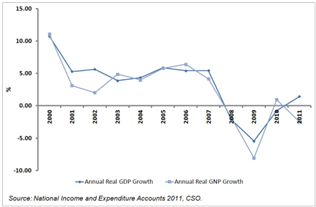
GNP in Ireland:  At the height of the Celtic Tiger period (mid 1990’s to mid 2000’s) GNP in Ireland was over 5%, however in the period 2007 to 2012 the growth rate of GNP in Ireland has been -2.2%.  The Economic and Social Research Institute (ESRI) propose that this was due to the global financial crises causing the Irish housing market to crash.  This in turn led to collapse of the construction and banking industries, resulting in Ireland entering a period of recession. This period has been characterised by high levels of state debt and unemployment.

graph for blog

GNP growth projections:  According to the latest report from ESRI, the GNP growth rate in coming years will be dependent on a number of factors, particularly the recovery of the EU economy, domestic policy decisions and the impact of changes in both the EU and Irish economies on domestic government finances.  The report explains that the current government policy-making position is a risk averse one of ‘no regrets’. Although not necessarily resulting in the ‘optimal’ policy option being selected, this approach should result in policy options which lead to generally positive outcomes across a range of possible scenarios being selected / implemented.  This is necessary given the current tenuous position of the Irish economy to withstand any additional shocks, as well as the high level of uncertainty in the economic environment both locally and more broadly in the EU and worldwide.

The ESRI report includes estimates of GNP growth rates in the medium term (2015 to 2020) under three recovery scenarios, ranging from stagnation to recovery.  See table below for summary of GNP growth under the three scenarios.

% GNP Change per year

 Scenario

2012

2013

2014

2015

2016

2017

2018

2019

2020

Recover

3.3

1.2

0.5

4.3

3.6

4

3.4

3.2

3.6

Delayed adjustment

3.3

1.3

-0.9

3

1.1

2.8

3.1

 –  –
Stagnation

3.3

1.2

0

1.9

0.6

2.1

0.4

0.9

1.7

This report provides an ideal source for the proxy wage growth estimates, as it takes into account many aspects of economic recovery you might not have considered.  For the calculation of productivity losses associated with cancer in Ireland, you could use the wage growth rate based on the forecast GNP growth rate from the recent ESRI report.   You can use the Delayed Adjustment scenario as the base case, with the Recovery and Stagnation scenarios providing upper and lower bounds for sensitivity analysis.

Extra considerations:  If using this, you need to be aware of a number of considerations:

  • You could calculate the growth adjustment per year for each year of lost productivity, or use the average of the annual % change for the years 2015 – 2030.  For my work, the changes between years are less important, and I will use the average.
  • The wage growth rate may not be consistent with reports of other improvements in the economy, making GNP growth a poor proxy.  This was well described in the Wall Street Journal article mentioned earlier, which discusses how the current pattern of economic recovery in the US is masking consistently low real wage growth rates.  In this case, you must weigh up using current real wage growth (which may not hold for the future) against using a potentially poor proxy but which has been projected to take account of the changing economic environment.  For my research, I believe that the uncertainty around economic recovery scenarios is more important than the potential difference between actual wage growth and the proxy value, so I am going to use the projected GNP growth.
  • As with any projection or forecast or prediction, it is almost certainly wrong!  So you need to carefully consider the uncertainty around the estimates and how they might influence your results.

Overall, this is a difficult economic time to be trying to make forecasts, however the very useful report from ESRI gives a good platform on which to form a base case and sensitivity analysis.  And remember, the most important component of choosing a growth rate (or any assumption in your model) is to have a justification for your choice of methods and sources.  

ISPOR 2013 Posters

I am attending the International Society for Pharmacoeconomics and Outcomes Research (ISPOR) conference in Dublin on the 2nd to the 6th of November. As part of this I am presenting two posters related to my PhD.

1. Can administrative data predict chemotherapy adverse events?

2. Australian standard costs and consequences of four chemotherapy adverse events.

As well as these being available at the conference and on the ISPOR website, I am making these available here via QR code.

If you are interested in the posters please feel free to get in touch, or if you are the conference come and say hi during the poster discussion hour on Monday evening.

Resources for Emerging Researchers

This blog post was originally written for and published by the Health Services Research Association of Australia and New Zealand (HSRAANZ) Emerging Researcher Group (ERGO) section of the December 2012 Newsletter. It has been, and will continue to be, updated as I find out about new resources.


The number of resources for PhD students and emerging researchers available on the internet has increased exponentially in recent years.  To assist in discovering those which can be the most helpful in navigating the difficult and often confusing (but very rewarding) path to an academic career, the ERGO group (with the assistance of the PhD Group at CHERE) has put together a list of online resources.  The list is aimed at early career researchers, including PhD students, but many of the resources listed may be of interest to anyone working in health services research.

Websites / blogs

Following the blogs of people in your field can expose you to the latest research, as well as upcoming conferences, funding opportunities.  There are also a number of websites and blogs aimed specifically at PhD students and early career researchers, often with a focus on writing.

Name Summary Web / Twitter
Incidental Economist “Contemplating health care with a focus on research, an eye on reform” http://theincidentaleconomist.com/
@IncidentalEcon
Thesis Whisperer “newspaper style blog dedicated to helping research students” http://thesiswhisperer.com/
@thesiswhisperer
Healthecon-all Subscription email list which distributes messages to the international health economics community.  Set up in 1995 it has 1300 members https://www.jiscmail.ac.uk/cgi-bin/webadmin?A0=HEALTHECON-ALL
@healtheconall
Academic HE Blog UK-centric blog for news, analysis and developments in health economics http://aheblog.com/
@aheblog
PHTwitter Journal Club ‘Meets’ fortnightly to discuss selected public health related academic papers http://phtwitjc.wordpress.com/
@PHTwitJC
Simply stats 3 biostats profs post interesting ideas, article links and advice for new statisticians. http://simplystatistics.org/
@simplystats
3-month thesis “uncommon guide to thesis writing & phd life” http://3monththesis.com/
@3monththesis
AcWriMo Academic Writing Month – set a writing goal, make it public, work on it in Nov 2012 #AcWriMo


Twitter feeds are another good way of staying in touch with people and organizations who work in a similar area.

  • Health economics – @ScHARR – HEDS; @HERC_Oxford; #healtheconomics;
  • PhD students / early career researchers – @PhD2Published; @hildabast; #PhDchat; #Ecrchat;


Organisations to join

The following organizations have opportunities or resources specifically for early career researchers and/or PhD students

Name Early career researcher specific activities and resources Web / Twitter
HSRAANZ
  • Discounted student membership prices and conference registration
  • Special interest group for emerging researchers (ERGO)
  • ERGO facebook page with sharing of information, resources and opportunities
  • Mentoring program
  • ERGO specific activities at bi-annual conference (including ERGO dinner and ERGO lunchtime session)
  • ERGO seminars and workshops
  • Job opportunities advertised through mailing list
  • PhD Student prize
www.hsraanz.org
ISPOR
  • Discounted student membership prices and conference registration
  • Research tools repository
  • Many educational opportunities (although not specific to ECR)
  • Job opportunities listing
http://www.ispor.org/
iHEA
  • Discounted student membership prices and conference registration
  • PhD scholarships for conference attendance
https://www.healtheconomics.org/
AHES
  • PhD scholarships for annual conference
http://www.ahes.org.au/
ISOQOL
  • New Investigators Special Interest Group
  • New Investigators Blog
http://newinvestigators-isoqol.blogspot.ie/

iPhone / iPad apps

These apps will all make your student / research life easier!

Name Summary
Dropbox To access all your docs from any computer, and this can include your EndNote library.  There is a special promotion at the moment if you have a student/uni email address you get an extra 3Gb storage
Endnote for iPad Access your EndNote library on the go. You will need to set up an EndNote web account, but then your articles, including PDF’s will be available anywhere, anytime.
GoodNotes To review/revise documents
EverNote For taking notes
TeamViewer To access your computer remotely
Toodledo To do list
Pomodoro Timers
  • Pomodoro Time Management Lite by rapidrabbit
  • Simple Pomodoro Timer from SourcePad
  • 30/30  – a more flexible version – you can set various time limits for a list of tasks, and it will tell you when to move on to the next one
  • http://mytomatoes.com/  –  a free online timer for desktop based pomodoros

Feedback?

Do you have an iPad app you couldn’t live without, or a blog that you really enjoy?  We would love to keep expanding and updating this list of resources, so please let us know if you have other resources that you find useful as an early career researcher.

My experience of working with data that isn’t ‘mine’

This blog post was originally written for and published by the Health Services Research Association of Australia and New Zealand (HSRAANZ) Emerging Researcher Group (ERGO) section of the August 2012 Newsletter.


During my PhD I was lucky enough to be offered access to a large dataset for analysis.  This was a fantastic opportunity, which has strengthened my PhD and my data management and analysis skills.  Logistically however, it was not always easy.  I learnt a number of lessons that I thought other early career researchers may find useful.

There were four main issues I encountered:

Physically accessing the data

The data was held at another institution, who had received ethics approval and access to the data on the basis that it was kept confidential and did not leave their secure building.  I therefore needed to go to their site to conduct the analysis.  Whilst this was not foreseen to be an issue, there was a huge amount of red tape to get access to the university building, a desk, a computer, a log-in etc, because I was neither a staff member nor a student at that university.

To avoid these issues, start planning logistics early, and be realistic about what you need.  ‘Hot desking’ is not as easy as it sounds, so if you need your own computer, or a larger than average hard drive, be specific.  Make sure you ask very specific questions very early on about how you will access buildings and resources such as stationary and software etc.

Working with data that wasn’t ‘mine’

It takes extra time to get to know your data when you haven’t been involved in collecting it.  A data dictionary can be extremely helpful in these situations, and it is worth continuing to ask for one, if it is not provided with your data.  The other issue with working with data that isn’t yours, is that you may end up waiting for other people to prepare or clean datasets before you can use them.  Obviously this impacts on timelines, so build in a generous buffer into your project plans.

Working with a very large dataset

My working data file was over 60Gb, and analysis code often took days to run.  The computer system at the University was not really configured to cope with work being done overnight, and so often my programs would get interrupted by virus scans and automated backups.  I ended up using a local drive and doing my own backups, to avoid the issue, but in future I would try to sort this out before starting.

Working off site

Finally, I have already covered some of the access issues of working off site, but the other issues this raised was that it was quite isolating.  There was no one there who was really responsible for my work or who understood my project and methods, and I couldn’t sit down and show my data to anyone at my PhD office.  It was also difficult to integrate time to be in two offices into my daily schedule.  Meetings and events often prevented me going for days at a time, by which time I had forgotten what I was working on!  The solution to this was to get as organized as possible, to keep detailed notes of what I did each day, and to use tools such as dropbox (where allowed) to keep track of things.