Our respondents didn’t understand these questions – do you?

Dr Alison Pearce has won a Best Poster Presentation Award at the Health Economics Study Group Winter Meeting 2016 (HESG) held in Manchester in January 2016. The award was given for Alison’s poster “Our respondents didn’t understand these questions – do you? Cognitive interviewing highlights unanticipated decision making in a discrete choice experiment.”

The poster described 17 interviews Alison conducted with cancer survivors about their care after finishing cancer treatment. During the interviews each survivor completed a survey about their care, but many found it very difficult.  Some of the problems with the survey are explained on the poster, but the poster was also interactive – conference attendees were asked to vote and comment on the survey questions. The poster received a great response, with many conference attendees voting and leaving comments about the research.

The National Cancer Registry is leading this research into cancer survivorship with a group of collaborators from Aberdeen, Dublin and Newcastle, with the aim of informing policy about the best way to structure follow-up services for survivors who have completed their cancer treatment. The Health Economics Study Group supports and promotes the work of health economists and is the oldest and one of the largest of its type.

This news article was originally posted on the 26th of January 2016 on the National Cancer Registry Ireland website: http://www.ncri.ie/news/article/registry-health-economist-wins-best-poster-presentation-award-recent-conference

Selecting a wage growth rate for economic evaluations in an uncertain economy

When doing economic evaluation you often need to forecast into the future.  And when projecting about earnings, you need to account for changes in the economy (for example, inflation). I am currently working on a study examining productivity losses associated with cancer in Ireland, and need to account for wage growth in the future.  But how do you do this when the economy is as uncertain as the current situation in Ireland?

Wage growth:  This Wall Street Journal blogpost describes wage growth as one of the key indicators of economic health (as well as some of the current problems with wage growth in the US).  In Ireland there are similar economic woes, but future predictions of the real wage growth rate are harder to come by.  Instead, people have used the Gross National Product (GNP) percentage change per year as a proxy for wage growth.  GNP is the total value of all products and services produced by residents of a country over a particular period of time.  Previous work similar to mine (Hanley 2012 & Hanley 2013) has used older versions of these predictions, which estimated an average growth rate of 2.6%.

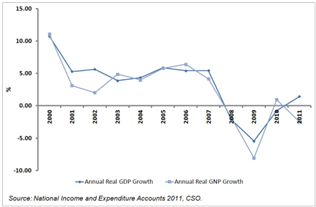
GNP in Ireland:  At the height of the Celtic Tiger period (mid 1990’s to mid 2000’s) GNP in Ireland was over 5%, however in the period 2007 to 2012 the growth rate of GNP in Ireland has been -2.2%.  The Economic and Social Research Institute (ESRI) propose that this was due to the global financial crises causing the Irish housing market to crash.  This in turn led to collapse of the construction and banking industries, resulting in Ireland entering a period of recession. This period has been characterised by high levels of state debt and unemployment.
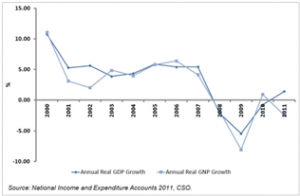
graph for blog

GNP growth projections:  According to the latest report from ESRI, the GNP growth rate in coming years will be dependent on a number of factors, particularly the recovery of the EU economy, domestic policy decisions and the impact of changes in both the EU and Irish economies on domestic government finances.  The report explains that the current government policy-making position is a risk averse one of ‘no regrets’. Although not necessarily resulting in the ‘optimal’ policy option being selected, this approach should result in policy options which lead to generally positive outcomes across a range of possible scenarios being selected / implemented.  This is necessary given the current tenuous position of the Irish economy to withstand any additional shocks, as well as the high level of uncertainty in the economic environment both locally and more broadly in the EU and worldwide.

The ESRI report includes estimates of GNP growth rates in the medium term (2015 to 2020) under three recovery scenarios, ranging from stagnation to recovery.  See table below for summary of GNP growth under the three scenarios.

% GNP Change per year

 Scenario

2012

2013

2014

2015

2016

2017

2018

2019

2020

Recover

3.3

1.2

0.5

4.3

3.6

4

3.4

3.2

3.6

Delayed adjustment

3.3

1.3

-0.9

3

1.1

2.8

3.1

 –  –
Stagnation

3.3

1.2

0

1.9

0.6

2.1

0.4

0.9

1.7

This report provides an ideal source for the proxy wage growth estimates, as it takes into account many aspects of economic recovery you might not have considered.  For the calculation of productivity losses associated with cancer in Ireland, you could use the wage growth rate based on the forecast GNP growth rate from the recent ESRI report.   You can use the Delayed Adjustment scenario as the base case, with the Recovery and Stagnation scenarios providing upper and lower bounds for sensitivity analysis.

Extra considerations:  If using this, you need to be aware of a number of considerations:

  • You could calculate the growth adjustment per year for each year of lost productivity, or use the average of the annual % change for the years 2015 – 2030.  For my work, the changes between years are less important, and I will use the average.
  • The wage growth rate may not be consistent with reports of other improvements in the economy, making GNP growth a poor proxy.  This was well described in the Wall Street Journal article mentioned earlier, which discusses how the current pattern of economic recovery in the US is masking consistently low real wage growth rates.  In this case, you must weigh up using current real wage growth (which may not hold for the future) against using a potentially poor proxy but which has been projected to take account of the changing economic environment.  For my research, I believe that the uncertainty around economic recovery scenarios is more important than the potential difference between actual wage growth and the proxy value, so I am going to use the projected GNP growth.
  • As with any projection or forecast or prediction, it is almost certainly wrong!  So you need to carefully consider the uncertainty around the estimates and how they might influence your results.

Overall, this is a difficult economic time to be trying to make forecasts, however the very useful report from ESRI gives a good platform on which to form a base case and sensitivity analysis.  And remember, the most important component of choosing a growth rate (or any assumption in your model) is to have a justification for your choice of methods and sources.  
Comparing the Australian and Irish Cancer Registries

Having just moved from Australia to Ireland to do a post-doc at the National Cancer Registry, I was interested in comparing the Australian and Irish cancer registration systems.  Both countries have excellent cancer registries, with some similarities as well as differences between them.  A table comparing the features of each system is below, but the primary differences are around the method of collecting data for the registry, and the amount of information captured.

In Ireland the Department of Health and Children has funded the National Cancer Registry Ireland since 1994.  Cancer registration is not mandatory.  However, data capture is close to complete through a system of active data collection through trained registry employees being stationed at hospitals around the country to collect cancer cases and data.  Most new registrations are identified through the pathology report, however public hospitals also produce lists of cancer cases discharged each year, and death notices are checked as well.  Six to twelve months after a new cancer notification, the tumour registration officer pulls the medical record for each notification, and completes the data entry.  Information is collected on the individual, the cancer and their initial treatments, with the full data list provided in the registry manual (p9) here.  Cancers are registered at the level of the individual, but are analysed at the tumour level.

In Australia, each state has an independent cancer registry, which reports a standardised minimum dataset to the National Cancer Statistics Clearinghouse at the Australian Institute for Health and Welfare (AIHW).  The New South Wales (NSW) registry, managed by the Cancer Institute NSW, is described here as an example.  Throughout Australia reporting of cancers (other than basal and squamous cell carcinomas of the skin) is mandatory, and whenever a hospital, pathology lab or radiotherapy centre deals with someone with cancer they are required by law to notify the cancer registry.  Basic demographic, cancer and doctor information is obtained and supplemented with pathology reports and death certificates; however this is less extensive than in the Irish system.  Cancers are registered at the tumour level.

Both registries produce very similar statistics such as incidence, prevalence and mortality rates, as well as specialised publications for topic areas of specific interest to the country.  Data is made available by both registries to the government and other researchers, following appropriate ethical review and de-identification.

Table 1: Features of the Irish and Australian cancer registries compared

Feature National Cancer Registry (NCR)   Ireland New South Wales (NSW) Central   Cancer Registry Australia Association of   Cancer Registries (AACR)
Funding Department of Health and Children NSW Health through Cancer Institute NSW Department of Health
Established 1994 1991.  Dataset dates back to   1972 1982
Direction provided by National Cancer Registry Board Cancer Information and Registries Advisory Committee within Cancer   Institute NSW The AACR Executive Committee advises the AIHW on the direction of the   National Cancer Statistics Clearinghouse (NCSCH) work program and the   development of publication topics and strategies, and provides technical   advice on the operation of the NCSCH.
Functions
  1.   to   identify, collect, classify, record, store and analyse information relating   to the incidence and prevalence of cancer and related tumours in Ireland
  2.   to   collect, classify, record and store information in relation to each newly   diagnosed individual cancer patient and in relation to each tumour which   occurs
  3.   to promote   and facilitate the use of the data thus collected in approved research and in   the planning and management of services;
  4.   to publish   an annual report based on the activities of the Registry;
  5.   to furnish   advice, information and assistance in relation to any aspect of such service   to the Minister.
  1.   act as a   population based register of all cancers in NSW residents
  2.   monitor   and undertake surveillance of new cases of cancer, survival and deaths in NSW
  3.   supply   timely and accurate data based on a total record of all cases diagnosed in   residents of NSW


  1.   analyse   and report on the data in its national repository of cancer incidence and   mortality statistics;
  2.   support   research based on these data; and
  3.   develop   and improve cancer statistics generally.
How are cancers registered The reporting of cancer is not mandatory, however the NCR uses active   ascertainment and follow up to ensure that there is accurate and complete   recording of all cases diagnosed. Tumour Registration Officers employed by   the registry are based at hospitals nationally.  The main source of notification of new   cases is a pathology report, however each public hospital provides a list of people   discharge with cancer which is checked against the registry, as well as   checking death notices and receiving notifications from registries in the UK. All Australian states and territories have legislation that makes the   reporting of all cancers (other than basal and squamous cell carcinomas of   the skin) mandatory. State and territory population-based cancer registries   receive information on cancer diagnoses from a variety of sources such as   hospitals, pathology laboratories, radiotherapy centres and registries of   births, deaths and marriages. When any of these institutions deal with   someone with cancer, they are required by law to notify the cancer   registries. The cancer   registry in each state or territory sends information to the National Cancer Statistics Clearing House at the AIHW to compile into a   national database of cancer incidence, the Australian Cancer Database.Cancer   data are also made available to the World Health Organization, state and local government   authorities, health care institutions, health professionals and medical   researchers.
What information is collected The medical records are retrieved 6 – 12 months after notification to   complete case information and capture relevant treatment information.  Validation checks are performed at the   point of entry and internal verifications are carried out monthly.  See page 9 of the manual (www.ncri.ie/ncri/foifiles/Manual.doc)   for details of data collected. The CCR records new cancer cases and does not capture cancer   recurrence.demographic information, brief medical details describing the cancer   and a record of at least one episode of care. The data are supplemented by   pathology reports and death certificates.
  •   name and   address
  •   sex
  •   date and   country of birth
  •   Aboriginal   or Torres Strait Islander descent
  •   clinical   details about the cancer
  •   the   notifying institution and doctor
Definition of a cancer Cancers are registered at the level of the individual, but are   analysed at the level of the cancer.  Metastasise   are associated with the primary tumour and not considered separate cancers. A case of cancer is the occurrence of a primary malignant neoplasm in   one organ of a particular person.    Therefore a case of malignant melanoma in an individual counts as one   case.  If the same person then develops   leukemia, this counts as a second case.


My sources, and for more information:

Cancer registration in Australia

http://www.cancerinstitute.org.au/data-and-statistics/cancer-registries/nsw-central-cancer-registry-data-access

http://www.abs.gov.au/ausstats/abs@.nsf/Lookup/3414.0main+features782011%20%28Edition%202%29

http://www.aihw.gov.au/cancer/aacr/

Cancer registration in Ireland

http://www.ncri.ie/ncri/index.shtml

www.ncri.ie/ncri/foifiles/Manual.doc

http://www.ncri.ie/pubs/pubfiles/CompletenessQuality.pdf