
Best Health Services and Policy Research Papers – 2018 Award winner

I was thrilled to be awarded the Overall winner of the 2018 HSRAANZ Best Health Services and Policy Research Paper last night. These awards recognise the best scientific works in the field health services and policy research. The award was for my paper on cancer-related lost productivity in the developing countries Brazil, Russia, India, China and South Africa (see my blog post for more details).

The article impressed the judges in the scope of research undertaken and the value it will contribute to the research field, including its potential to guide local prevention and treatment strategies. (HSRAANZ)

For the paper I was responsible for leading a large, international team of researchers to conduct an analysis of productivity loss due to cancer in rapidly developing countries. I had a leading role in the conceptualisation of both the research question and the project methodology, and applied for and received funding through an EU CANWON fellowship to undertake the project. I gathered the necessary data with assistance from the international authors, and was solely responsible for the formal data analysis. As the lead author, I was also responsible for the project administration and preparation of the manuscript.

Following publication of the paper, I lead the promotion of the publication through various media channels, including The Conversation (~6,000 readers) and 44 radio, print and tv news articles (including The Guardian, Lancet Oncology News, UN News, 2SER ThinkHealth podcast, etc.) As a result, the article has gone on to be in the top 5% of all research outputs scored by Altmetrics, and the number 1 article of similar age published in Cancer Epidemiology. More importantly, I have worked with each of the international authors to ensure that the results have been disseminated to the appropriate policy and health service planning agencies and individuals in each of the BRICS countries. This has included developing country-specific specific results and graphs, assisting with presentation slides and encouraging broad dissemination lead by the other authors.

The above two paragraphs are a summary of the application I submitted to HSRAANZ for the award, and while it is true it skips the importance of this paper as part of my professional development. I was so lucky to be supported by Linda Sharp, Isabelle Soerjomataram and Paul Hanly to lead the research, and to apply for and take up funding to visit IARC and get the project started. The team we pulled together were really engaged with the project, and instrumental in pulling together and then interpreting the local and international data. I now count them as ongoing collaborators, and we already have a few papers and grant applications in the works.

But perhaps the most important lesson from this paper was resilience. I was so proud of this work once it was finished, but it took more than 12 months, an international relocation and 7 journal rejections before it was published. During that year I learnt perseverance and the value of a few days ‘cooling off’ before commencing the reformatting process, as well as how wonderful it is to have co-authors who will keep the faith in the manuscript alive when you (temporarily) run out! So thank you to everyone who helped out on the paper in whatever way – from digging out local data to offering supportive glasses of wine after another rejection! It was all worth it.
$46 billion in productivity lost to cancer in developing countries

Premature – and potentially avoidable – death from cancer is costing tens of billions of dollars in lost productivity in a group of key developing economies that includes China, India and South Africa.

Over two-thirds of the world’s cancer deaths occur in economically developing countries, but the societal costs of cancer have rarely been assessed in these settings.

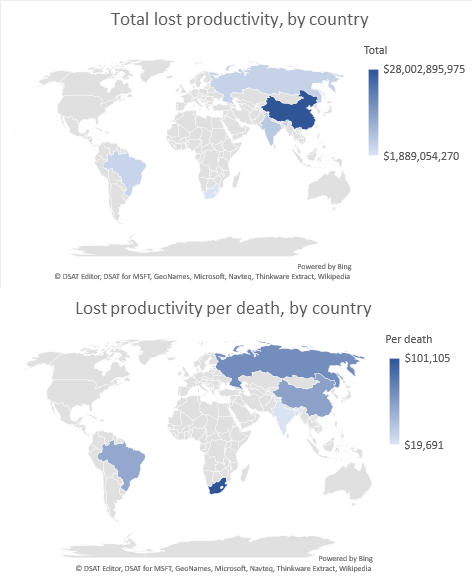
In a paper to be published in the journal Cancer Epidemiology we show that the total cost of lost productivity due to premature cancer mortality in Brazil, Russia, India, China and South Africa, collectively known as the BRICS countries, was $46.3 billion in 2012 (the most recent year for which cancer data was available for all these nations).

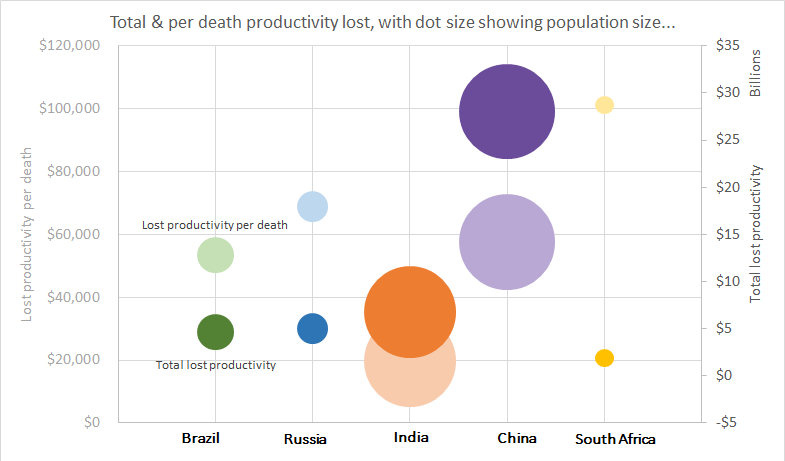
The largest loss was in China ($28 billion), while South Africa had the highest cost per cancer death ($101,000).

The BRICS countries are diverse but have been grouped by economists and others because of their particularly rapid demographic and economic growth. Currently the five countries combined comprise over 40% of the world’s population and 25% of global gross domestic product.

Liver and lung cancers had the largest impact on total lost productivity across the BRICS countries due to their high incidence, our research found.

But in South Africa, there are high productivity losses per death due to AIDS-related Kaposi sarcoma – an indication of the magnitude of the HIV/AIDS epidemic in Sub-Saharan Africa, and in India, lip and oral cancers dominated due to the prevalence of chewing tobacco there.

Many cancers which result in high lost productivity in the BRICS countries are amenable to prevention, early detection or treatment. Sadly, and in contrast to developed countries, most developing countries do not have such programs.

In particular, tobacco- and infection-related cancers (such as liver, cervical, stomach cancers and Kaposi sarcoma) were major contributors to productivity losses across BRICS countries.

Beyond the evident public health impact, cancer also imposes economic costs on individuals and society. These costs include lost productivity — where society loses the contribution of an individual to the market economy because they died prematurely from cancer.

Valuing this lost production gives policy- and decision-makers an additional perspective when identifying priorities for cancer prevention and control. This is particularly important in developing economies, where workforce and productivity are key resources in ensuring sustained economic growth.

Developing economies often have different demography, exposure to cancer risk factors, and economic environments than developed countries – all of which could modify the economic impact of cancer.

Locally tailored strategies are required to reduce the economic burden of cancer in developing economies. Focussing on tobacco control, vaccination programs and cancer screening, combined with access to adequate treatment, could yield significant gains for both public health and economic performance of the BRICS countries.

Country specific results

Brazil:

  • In Brazil, lung cancer resulted in the greatest productivity losses ($0.5 billion in 2012), with $402 million in lost productivity each year due to tobacco smoking, although Brazil has recently implemented successful tobacco use reduction policies.
  • Rapidly growing rates of obesity in Brazil result in up to $126 million in lost productivity due to cancer each year.

Russian Federation:

  • Total productivity lost due to cancer in the Russian Federation were $5 billion in 2012. They had the second highest cost per death of the BRICS countries.
  • Both liver and head and neck cancers contribute to the high number of excess alcohol-related deaths in the Russian Federation, with a likely considerably economic impact.

India:

  • Lip and oral cancers dominate lost productivity in India due to the relatively high prevalence of chewing tobacco. The use of smokeless tobacco, often combined with betel quid, may account for lost productivity of $486 million each year.
  • In India, the lost productivity costs per death of leukaemia are relatively high, perhaps because the advanced, multi-modality treatments required are not available, or are difficult to access

China:

  • Productivity lost due to cancer in China was $26 billion in 2012, more than all the other BRICS countries combined.
  • Two-thirds of total lost productivity costs in China were in urban areas (66%), considerably more than the proportion of people who reside in urban areas (52%).
  • In China, dietary aflatoxins in many staple foods is a major risk factor for liver cancer, and our results suggest this costs the economy $972 million annually.

South Africa:

  • In South Africa there are high productivity losses per death due to AIDS-related Kaposi sarcoma – an indication of the magnitude of the HIV/AIDS epidemic in Sub-Saharan Africa.
  • Cervical cancer represents a particularly large economic impact in South Africa. While there are new vaccinations available to prevent HPV, one of the precursors to cervical cancer, the effects of vaccination need a few decades to show impact. In the meantime, cervical cancer screening can offer an effective solution to reduce both the public health and economic burden of cervical cancer.

ISPOR Best New Investigator Award

Dr Alison Pearce has won a Best New Investigator Presentation Award at the Annual European Congress of the International Society for Pharmacoeconomics and Outcomes Research (ISPOR). The award recognises the scientific merit of a podium presentation at the conference, which was held in Milan, Italy.

The award was given for Alison’s work which found that lost productivity due to cancer in Brazil, Russia, India, China and South Africa costs around $47 billion US dollars annually.

When people die from cancer, their contribution to society through paid work, called productivity, is lost. Over 70% of cancer deaths in the world occur in developing countries, and Brazil, Russia, India, China and South Africa (the BRICS countries) are the most rapidly developing economies in the world. The results highlight the importance of tobacco control, vaccination for hepatitis, and improved access to early detection and treatment in developing countries.

The National Cancer Registry is leading this research with a group of collaborators from around the world, including the International Agency for Research on Cancer (IARC) in France and researchers in Ireland, the UK, Brazil, Russia, India, China and South Africa. ISPOR is a non-profit, international, educational and scientific organisation that promotes health economics and outcomes research excellence to improve decision making for health globally.

This news item was originally published on the National Cancer Registry Ireland website: http://www.ncri.ie/news/article/dr-alison-pearce-health-economist-registry-wins-prestigious-conference-award 

Research on the costs of cancer to be presented at an international conference in India

Cancer deaths in Brazil, Russia, India, China and South Africa (the largest emerging economies in the world) result in over $51 billion (USD) in lost productivity each year. These results are being presented at an international conference in India today.

Researchers at the National Cancer Registry Ireland (NCRI) have estimated that lost productivity due to cancer deaths costs China over $28 billion each year, followed by India ($6.7 billion), Russia ($5 billion), Brazil ($4.6 billion) and finally South Africa ($2.8 billion) each year.

When people die due to cancer, their contribution to society through paid work, called productivity, is lost. Over 70% of cancer deaths in the world occur in developing countries, and Brazil, Russia, India, China and South Africa (together known as the BRICS countries) are the most rapidly emerging economies in the world. Leading an international collaboration of researchers, the NCRI have been investigating productivity loss in the BRICS countries.

The analysis shows cancers related to tobacco contribute between 27% (South Africa) and 38% (India) of productivity losses across the BRICS countries. Over half of men in Russia and India smoke, and it is clear that anti-tobacco legislation is an important part of cancer control in the BRICS countries.

The analysis also shows the potential importance of vaccinations for hepatitis and HPV in BRICS countries. Cancers such as liver cancer, cervical cancer and head and neck cancers are all preventable with these vaccinations, but continue to have a high impact on lost productivity in BRICS countries.

These results are being presented today at the annual conference of theInternational Association of Cancer Registries (IACR). The conference is being held in Mumbai, India, and aims to provide people working in cancer registries with a forum for learning and exchanging ideas. The work has been done with a group of international collaborators, including from the International Agency for Research on Cancer (IARC) in France, and researchers in Ireland, the UK, Brazil, Russia, India and China.

This news item was originally published on the National Cancer Registry Ireland website: http://www.ncri.ie/news/article/registry-research-costs-cancer-be-presented-international-conference-india

The cost to society for time off work after head and neck cancer

When people take time off work because of cancer, society loses their contribution to the economy. Our new study looks at different ways of valuing this contribution.

Most people with cancer take some time off work for treatment, recuperation and rehabilitation. As well as impacting on a person’s sense of identity and quality of life, this time away from work has implications for society, because each individual in the workforce contributes to the economy. This contribution to the economy is known as productivity. Estimating the productivity lost due to a disease can help with health care service planning and policy making.

This study estimated the productivity lost due to time off work and premature mortality from head and neck cancer in Ireland using two different methods. Both methods found that productivity losses following head and neck cancer are substantial, and are higher than seen in other cancers. For each working person diagnosed with head and neck cancer, the first method found that society loses on average €253,800, while the second approach found that on average society loses €6,800.

The two methods had very different results because they have different assumptions about what is included in lost productivity. For example, if someone retires early because of cancer, the first method includes a value for each year until they should have retired. In contrast, the second method only includes the time it takes until their position has been filled.

These contrasting results highlight that using different methods to estimate the impact of a disease on the economy can have very different results. At the moment, there is no consensus on the best method to use. Our research suggests that using both approaches, as we have done, is a good way of estimating  the range of the potential productivity losses.

This news item was originally published on the National Cancer Registry Ireland website: http://www.ncri.ie/news/article/cost-society-time-work-after-head-and-neck-cancer