
Best Health Services and Policy Research Papers – 2018 Award winner

I was thrilled to be awarded the Overall winner of the 2018 HSRAANZ Best Health Services and Policy Research Paper last night. These awards recognise the best scientific works in the field health services and policy research. The award was for my paper on cancer-related lost productivity in the developing countries Brazil, Russia, India, China and South Africa (see my blog post for more details).

The article impressed the judges in the scope of research undertaken and the value it will contribute to the research field, including its potential to guide local prevention and treatment strategies. (HSRAANZ)

For the paper I was responsible for leading a large, international team of researchers to conduct an analysis of productivity loss due to cancer in rapidly developing countries. I had a leading role in the conceptualisation of both the research question and the project methodology, and applied for and received funding through an EU CANWON fellowship to undertake the project. I gathered the necessary data with assistance from the international authors, and was solely responsible for the formal data analysis. As the lead author, I was also responsible for the project administration and preparation of the manuscript.

Following publication of the paper, I lead the promotion of the publication through various media channels, including The Conversation (~6,000 readers) and 44 radio, print and tv news articles (including The Guardian, Lancet Oncology News, UN News, 2SER ThinkHealth podcast, etc.) As a result, the article has gone on to be in the top 5% of all research outputs scored by Altmetrics, and the number 1 article of similar age published in Cancer Epidemiology. More importantly, I have worked with each of the international authors to ensure that the results have been disseminated to the appropriate policy and health service planning agencies and individuals in each of the BRICS countries. This has included developing country-specific specific results and graphs, assisting with presentation slides and encouraging broad dissemination lead by the other authors.

The above two paragraphs are a summary of the application I submitted to HSRAANZ for the award, and while it is true it skips the importance of this paper as part of my professional development. I was so lucky to be supported by Linda Sharp, Isabelle Soerjomataram and Paul Hanly to lead the research, and to apply for and take up funding to visit IARC and get the project started. The team we pulled together were really engaged with the project, and instrumental in pulling together and then interpreting the local and international data. I now count them as ongoing collaborators, and we already have a few papers and grant applications in the works.

But perhaps the most important lesson from this paper was resilience. I was so proud of this work once it was finished, but it took more than 12 months, an international relocation and 7 journal rejections before it was published. During that year I learnt perseverance and the value of a few days ‘cooling off’ before commencing the reformatting process, as well as how wonderful it is to have co-authors who will keep the faith in the manuscript alive when you (temporarily) run out! So thank you to everyone who helped out on the paper in whatever way – from digging out local data to offering supportive glasses of wine after another rejection! It was all worth it.
1 in 5 people with cancer report financial difficulties

More than 20% of people with cancer in the Netherlands report financial difficulties as a result of their cancer care. If they are unemployed, this goes up to over 25%, as found in a paper published today in the Journal of Cancer Survivorship.

Dr Alison Pearce, the lead author on the study explains “People often think about the extra costs of cancer care putting financial strain on patients and their families. We were interested in whether having difficulties maintaining a job during cancer treatment might also impact people’s financial worries.”

Financial difficulties were also more common for men, young people, people who weren’t married, and people who had lower education or socioeconomic status. For many people in these groups, financial reserves and flexibility might be limited. For example, young people may not have had time to save money for situations like this, or people working casual jobs might have lower income as well as less access to sick leave.

Professor Dr Lonneke van de Poll-Franse from the PROFILES registry that provided the data: “Although in the Netherlands, like Australia, we have a good social security system to pay for cancer treatment and disability, people still experience financial difficulties. More attention should be paid to the potential origins of this problem, for example maintaining employment, getting a mortgage or insurance or missing out on work-related financial bonusses.”

Some types of cancer were more likely to result in financial difficulties. People who had blood cancer or colorectal cancer were more likely to feel stress due to the costs of cancer, while people with a type of skin cancer called Basal Cell Carcinoma were less likely to experience financial stress.  This may reflect the duration and complexity of treatment for different cancers.

Just like the physical side effects of treatment reduce after stopping treatment, the chances of financial difficulties also reduced over time.

Dr Pearce says “This is probably related to people going back to work. But, we know financial difficulties reduce quality of life. So, it would be better if we could help people to avoid or minimise financial problems, rather than just waiting for them to go away.”

Introducing return to work programs for cancer survivors might be one way to prevent or reduce financial difficulties among cancer survivors. Research suggest that multidisciplinary teams involving physical therapy, psychological support and workplace specific training have been effective in helping people return to work.


Link to paper: A Pearce, B Tomalin, B Kaambwa, N Horevoorts, S Duijts, F Mols, L van de Poll-Franse, B Koczwara. Financial toxicity is more than costs of care: The relationship between employment and financial toxicity in long-term cancer survivors. Journal of Cancer Survivorship. Published online 24th October 2018.

About the authors: This research was conducted by a collaborative group, with researchers from the University of Technology Sydney, Flinders University, the Netherlands Comprehensive Cancer Organisation, the University Medical Center Groningen, and Tilburg University.

About PROFILES: PROFILES (Patient Reported Outcomes Following Initial treatment and Long-term Evaluation of Survivorship) is a registry for the study of the physical and psychosocial impact of cancer and its treatment from a dynamic, growing population-based cohort of both short and long-term cancer survivors. Researchers from the Netherlands Comprehensive Cancer Organisation and Tilburg University in Tilburg, The Netherlands, work together with medical specialists from national hospitals in order to setup different PROFILES studies, collect the necessary data, and present the results in scientific journals and (inter)national conferences.

For more information contact:

Alison Pearce: Alison.pearce@chere.uts.edu.au

$46 billion in productivity lost to cancer in developing countries

Premature – and potentially avoidable – death from cancer is costing tens of billions of dollars in lost productivity in a group of key developing economies that includes China, India and South Africa.

Over two-thirds of the world’s cancer deaths occur in economically developing countries, but the societal costs of cancer have rarely been assessed in these settings.

In a paper to be published in the journal Cancer Epidemiology we show that the total cost of lost productivity due to premature cancer mortality in Brazil, Russia, India, China and South Africa, collectively known as the BRICS countries, was $46.3 billion in 2012 (the most recent year for which cancer data was available for all these nations).

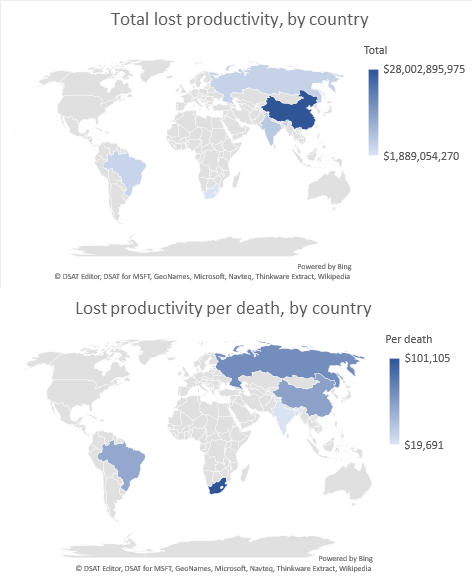
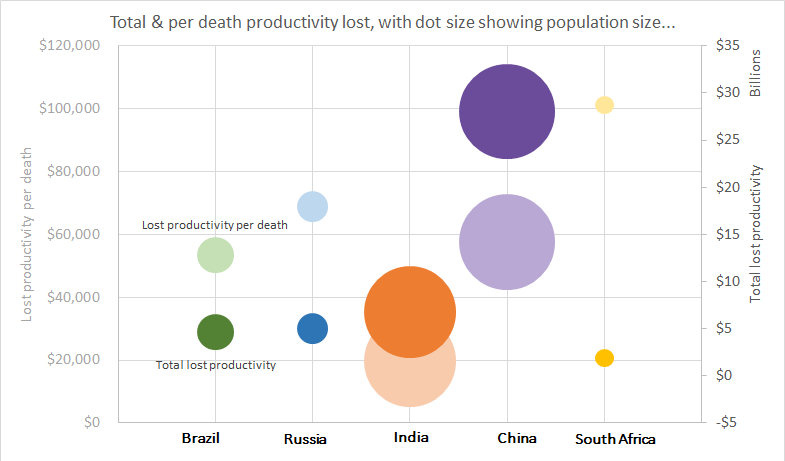
The largest loss was in China ($28 billion), while South Africa had the highest cost per cancer death ($101,000).

The BRICS countries are diverse but have been grouped by economists and others because of their particularly rapid demographic and economic growth. Currently the five countries combined comprise over 40% of the world’s population and 25% of global gross domestic product.

Liver and lung cancers had the largest impact on total lost productivity across the BRICS countries due to their high incidence, our research found.

But in South Africa, there are high productivity losses per death due to AIDS-related Kaposi sarcoma – an indication of the magnitude of the HIV/AIDS epidemic in Sub-Saharan Africa, and in India, lip and oral cancers dominated due to the prevalence of chewing tobacco there.

Many cancers which result in high lost productivity in the BRICS countries are amenable to prevention, early detection or treatment. Sadly, and in contrast to developed countries, most developing countries do not have such programs.

In particular, tobacco- and infection-related cancers (such as liver, cervical, stomach cancers and Kaposi sarcoma) were major contributors to productivity losses across BRICS countries.

Beyond the evident public health impact, cancer also imposes economic costs on individuals and society. These costs include lost productivity — where society loses the contribution of an individual to the market economy because they died prematurely from cancer.

Valuing this lost production gives policy- and decision-makers an additional perspective when identifying priorities for cancer prevention and control. This is particularly important in developing economies, where workforce and productivity are key resources in ensuring sustained economic growth.

Developing economies often have different demography, exposure to cancer risk factors, and economic environments than developed countries – all of which could modify the economic impact of cancer.

Locally tailored strategies are required to reduce the economic burden of cancer in developing economies. Focussing on tobacco control, vaccination programs and cancer screening, combined with access to adequate treatment, could yield significant gains for both public health and economic performance of the BRICS countries.

Country specific results

Brazil:

  • In Brazil, lung cancer resulted in the greatest productivity losses ($0.5 billion in 2012), with $402 million in lost productivity each year due to tobacco smoking, although Brazil has recently implemented successful tobacco use reduction policies.
  • Rapidly growing rates of obesity in Brazil result in up to $126 million in lost productivity due to cancer each year.

Russian Federation:

  • Total productivity lost due to cancer in the Russian Federation were $5 billion in 2012. They had the second highest cost per death of the BRICS countries.
  • Both liver and head and neck cancers contribute to the high number of excess alcohol-related deaths in the Russian Federation, with a likely considerably economic impact.

India:

  • Lip and oral cancers dominate lost productivity in India due to the relatively high prevalence of chewing tobacco. The use of smokeless tobacco, often combined with betel quid, may account for lost productivity of $486 million each year.
  • In India, the lost productivity costs per death of leukaemia are relatively high, perhaps because the advanced, multi-modality treatments required are not available, or are difficult to access

China:

  • Productivity lost due to cancer in China was $26 billion in 2012, more than all the other BRICS countries combined.
  • Two-thirds of total lost productivity costs in China were in urban areas (66%), considerably more than the proportion of people who reside in urban areas (52%).
  • In China, dietary aflatoxins in many staple foods is a major risk factor for liver cancer, and our results suggest this costs the economy $972 million annually.

South Africa:

  • In South Africa there are high productivity losses per death due to AIDS-related Kaposi sarcoma – an indication of the magnitude of the HIV/AIDS epidemic in Sub-Saharan Africa.
  • Cervical cancer represents a particularly large economic impact in South Africa. While there are new vaccinations available to prevent HPV, one of the precursors to cervical cancer, the effects of vaccination need a few decades to show impact. In the meantime, cervical cancer screening can offer an effective solution to reduce both the public health and economic burden of cervical cancer.

Comparing the Australian and Irish Cancer Registries

Having just moved from Australia to Ireland to do a post-doc at the National Cancer Registry, I was interested in comparing the Australian and Irish cancer registration systems.  Both countries have excellent cancer registries, with some similarities as well as differences between them.  A table comparing the features of each system is below, but the primary differences are around the method of collecting data for the registry, and the amount of information captured.

In Ireland the Department of Health and Children has funded the National Cancer Registry Ireland since 1994.  Cancer registration is not mandatory.  However, data capture is close to complete through a system of active data collection through trained registry employees being stationed at hospitals around the country to collect cancer cases and data.  Most new registrations are identified through the pathology report, however public hospitals also produce lists of cancer cases discharged each year, and death notices are checked as well.  Six to twelve months after a new cancer notification, the tumour registration officer pulls the medical record for each notification, and completes the data entry.  Information is collected on the individual, the cancer and their initial treatments, with the full data list provided in the registry manual (p9) here.  Cancers are registered at the level of the individual, but are analysed at the tumour level.

In Australia, each state has an independent cancer registry, which reports a standardised minimum dataset to the National Cancer Statistics Clearinghouse at the Australian Institute for Health and Welfare (AIHW).  The New South Wales (NSW) registry, managed by the Cancer Institute NSW, is described here as an example.  Throughout Australia reporting of cancers (other than basal and squamous cell carcinomas of the skin) is mandatory, and whenever a hospital, pathology lab or radiotherapy centre deals with someone with cancer they are required by law to notify the cancer registry.  Basic demographic, cancer and doctor information is obtained and supplemented with pathology reports and death certificates; however this is less extensive than in the Irish system.  Cancers are registered at the tumour level.

Both registries produce very similar statistics such as incidence, prevalence and mortality rates, as well as specialised publications for topic areas of specific interest to the country.  Data is made available by both registries to the government and other researchers, following appropriate ethical review and de-identification.

Table 1: Features of the Irish and Australian cancer registries compared

Feature National Cancer Registry (NCR)   Ireland New South Wales (NSW) Central   Cancer Registry Australia Association of   Cancer Registries (AACR)
Funding Department of Health and Children NSW Health through Cancer Institute NSW Department of Health
Established 1994 1991.  Dataset dates back to   1972 1982
Direction provided by National Cancer Registry Board Cancer Information and Registries Advisory Committee within Cancer   Institute NSW The AACR Executive Committee advises the AIHW on the direction of the   National Cancer Statistics Clearinghouse (NCSCH) work program and the   development of publication topics and strategies, and provides technical   advice on the operation of the NCSCH.
Functions
  1.   to   identify, collect, classify, record, store and analyse information relating   to the incidence and prevalence of cancer and related tumours in Ireland
  2.   to   collect, classify, record and store information in relation to each newly   diagnosed individual cancer patient and in relation to each tumour which   occurs
  3.   to promote   and facilitate the use of the data thus collected in approved research and in   the planning and management of services;
  4.   to publish   an annual report based on the activities of the Registry;
  5.   to furnish   advice, information and assistance in relation to any aspect of such service   to the Minister.
  1.   act as a   population based register of all cancers in NSW residents
  2.   monitor   and undertake surveillance of new cases of cancer, survival and deaths in NSW
  3.   supply   timely and accurate data based on a total record of all cases diagnosed in   residents of NSW


  1.   analyse   and report on the data in its national repository of cancer incidence and   mortality statistics;
  2.   support   research based on these data; and
  3.   develop   and improve cancer statistics generally.
How are cancers registered The reporting of cancer is not mandatory, however the NCR uses active   ascertainment and follow up to ensure that there is accurate and complete   recording of all cases diagnosed. Tumour Registration Officers employed by   the registry are based at hospitals nationally.  The main source of notification of new   cases is a pathology report, however each public hospital provides a list of people   discharge with cancer which is checked against the registry, as well as   checking death notices and receiving notifications from registries in the UK. All Australian states and territories have legislation that makes the   reporting of all cancers (other than basal and squamous cell carcinomas of   the skin) mandatory. State and territory population-based cancer registries   receive information on cancer diagnoses from a variety of sources such as   hospitals, pathology laboratories, radiotherapy centres and registries of   births, deaths and marriages. When any of these institutions deal with   someone with cancer, they are required by law to notify the cancer   registries. The cancer   registry in each state or territory sends information to the National Cancer Statistics Clearing House at the AIHW to compile into a   national database of cancer incidence, the Australian Cancer Database.Cancer   data are also made available to the World Health Organization, state and local government   authorities, health care institutions, health professionals and medical   researchers.
What information is collected The medical records are retrieved 6 – 12 months after notification to   complete case information and capture relevant treatment information.  Validation checks are performed at the   point of entry and internal verifications are carried out monthly.  See page 9 of the manual (www.ncri.ie/ncri/foifiles/Manual.doc)   for details of data collected. The CCR records new cancer cases and does not capture cancer   recurrence.demographic information, brief medical details describing the cancer   and a record of at least one episode of care. The data are supplemented by   pathology reports and death certificates.
  •   name and   address
  •   sex
  •   date and   country of birth
  •   Aboriginal   or Torres Strait Islander descent
  •   clinical   details about the cancer
  •   the   notifying institution and doctor
Definition of a cancer Cancers are registered at the level of the individual, but are   analysed at the level of the cancer.  Metastasise   are associated with the primary tumour and not considered separate cancers. A case of cancer is the occurrence of a primary malignant neoplasm in   one organ of a particular person.    Therefore a case of malignant melanoma in an individual counts as one   case.  If the same person then develops   leukemia, this counts as a second case.


My sources, and for more information:

Cancer registration in Australia

http://www.cancerinstitute.org.au/data-and-statistics/cancer-registries/nsw-central-cancer-registry-data-access

http://www.abs.gov.au/ausstats/abs@.nsf/Lookup/3414.0main+features782011%20%28Edition%202%29

http://www.aihw.gov.au/cancer/aacr/

Cancer registration in Ireland

http://www.ncri.ie/ncri/index.shtml

www.ncri.ie/ncri/foifiles/Manual.doc

http://www.ncri.ie/pubs/pubfiles/CompletenessQuality.pdf