Work, daily activities and leisure after cancer

As well as being less likely to work, cancer survivors of working age were more likely to be limited in their daily activities and leisure compared to people who had not had cancer, our latest research finds. Similarly, older cancer survivors (aged over 65) were also more likely to be limited in their leisure pursuits compared with people without cancer.

We know that cancer can impact on people’s paid work status and participation. The percentage of people who return to work after cancer varies from 24% to 94%, and depends on several factors such as health status, socio-demographics, work characteristics and the availability of support from others.

However, there has been far less research on whether it also changes people’s daily activities and leisure. What is available suggests nearly half of people with cancer experience trouble with daily activities such as meal preparation and grocery shopping. There is also evidence that participation in leisure is reduced after cancer, although this work has largely focussed on physical activity and exercise, with very little examination of cultural activities, hobbies or socialising.

Our latest paper, published this week, addresses this gap by looking at whether people with cancer report more limitations in their daily activities and leisure compared to people without cancer. We used the PROFILES Registry, a population-based registry of short and long-term cancer survivors in the Netherlands, collected through a series of cohort studies conducted between 2004 and 2015. Our sample included nearly 2000 cancer survivors, across five cancer types: Hodgkin’s lymphoma, non-Hodgkin’s lymphoma, multiple myeloma, thyroid cancer and prostate cancer. We also had a sample of over 1600 people who had not had cancer.

Among those of working age, 55% of those in the cancer cohort reported participating in paid work, 41% experienced limitations in daily activities and 41% reported limitations in leisure. This was significantly worse than in the working age non-cancer control group, where 66% reported participating in paid work, 22% reported limitations with daily activities and 20% reported limitations with leisure. Among those of retirement age, the non-cancer control group were significantly less likely to have limitations in leisure (30%) than the cancer cohort (39% limited in leisure) but there was no difference in daily activities (40% and 36% respectively).

In particular, Hodkin’s lymphoma survivors had much lower rates of paid work and more difficulty with daily activities and leisure, likely due to the impact of the disease symptoms, extensive treatment and associated side effects, and the probability of relapse. Conversely, thyroid cancer survivors tend to be younger at diagnosis and have less intensive treatment, perhaps explaining why they were more likely in our sample, and equally likely in previous studies, to have a paid job when compared to people who had not had cancer.

While previous research suggests some people reassess their life roles and choose to reduce their work to spend more time in unpaid daily activities and leisure after cancer our results suggest those who are limited in paid work are also limited in their daily activities. This may simply reflect that many who do reassess their roles still rely on work for financial reasons and continue despite limitations in their physical or psychosocial abilities.

Further research to examine how cancer survivors can best be supported to participate in unpaid work and leisure activities is required, given the previous focus of the cancer survivorship literature on return to paid work. Factors which have been shown to improve rates of return to paid work, such as support from family and friends, support of employers and participation in specific rehabilitation programs may also apply to unpaid daily activities and leisure activities.

Participation and limitations in daily activities such as (un)paid work and leisure form significant parts of a person’s identity and are therefore an important component of survivorship care. However, the limited evidence in this area includes very few studies with larger samples or with a range of cancer types. Understanding the impact of cancer on unpaid work, daily activities and leisure may encourage clinicians and health services to take a more holistic view of cancer survivorship.

Co-authors: Marjon Faaij (University Utrecht visiting scholar to the Centre for Health Economics Research and Evaluation at UTS, funded by the Cancer Research Economics Support Team) & Dounya Schoormans (Department of Medical and Clinical Psychology, Tilburg University, Tilburg, The Netherlands).

What I learned during #AcWriMo 2019

I started #AcWriMo 2019 with all the best of intentions, but life really did get in the way this year. If you don’t know about Academic Writing Month (AcWriMo), it was started by PhD2Published, but is now a world wide gathering in November each year of academics wanting a  writing boost. There’s more detail in this post by the Thesis Whisperer, but the basic components are to set some serious writing goals for the month (such as 10,000 words total or half an hour a day), make yourself publicly accountable by posting them online, and then start writing! Throughout the month you update your online spreadsheet to stay accountable, and also get the support of a whole community of #AcWriMo participants, particularly on twitter.

I’ve participated a few times in the past with mixed success, but I was sure this year was going to be amazing. I had some really clear goals, time available and had even organised a 3-day writing retreat! But despite all this it was hard and I didn’t get as much done as I’d hoped. Overall I only did 47% of my scheduled writing time (and gave up on the 26th of November), although I managed to write 81% of my target words. These is some of the things I learned as I struggled through:

  1. Public accountability is good! Having a small group of twitter people I touched base with on a Friday really helped me to stay on track. Thanks @LaurenJchristie @AnnieMcCluskey2 @Lisa_Beatty & @lnraines1!
  2. I thought I’d love filling in my google spreadsheet, but actually much preferred colouring squares on my manual whiteboard tracker (see image above). Being able to visualise the progress was really motivational.
  3. Tracking both time and words written was important – sometimes I had put in the time but hadn’t written words because I was thinking about structure or re-arranging text. This time was still valuable, but if I’d only been tracking words it would have been disheartening.
  4. I love the concept of ‘Low hanging fruit’ to start and finish a writing session. The concept was referred in either the Acadames podcast or the Good, Bad & Ugly of Writing in Academia podcast (sorry I can’t remember or find which, but both are worth listening to!) and means leaving a note to myself about where I am up to or leaving a sentence half finished. This gave me a quick and easy way to get straight back into writing in the next session, rather than feeling like I needed to reread the whole thing to remember what I was talking about.
  5. I can accomplish a LOT in one pomodoro (25 minutes). I quickly realised that, for me, the challenge of writing is not coming up with the words, but is just sitting down, sitting still and sticking to it.
  6. I can only do about 2 or 3 pomodoros in a block. Doing one by itself often felt a bit short, but 4 in a row fried my brain. Doing 2 blocks of 3 pomodoros (so about 3 hours of writing) in a day was super productive and felt very achievable.
  7. Having a physical break, such as stretching, going for a quick walk or making a cup of tea, between pomodoros was much more refreshing than just checking email or looking at my phone.
  8. The writing retreat was cancelled in the end, but I had a great few days doing writing sessions in various cafes and libraries on campus with my writing buddy @CStatsAU. Changing the location and writing with someone else was fun and I’m thrilled that we now have a writing accountability in my office.
  9. @LaurenJchristie gave me the great idea to also track self-care activities in my tracking spreadsheet, not as yet another ‘thing to do’ but to remind me that I can support myself to write productively in ways that don’t involve sitting in front of the computer.
  10. Life gets in the way sometimes. Although this was disappointing at times, tracking how much I had been able to do and accomplish actually meant that I was less frustrated, because I could see that I was making progress despite having so many competing demands. It also helped that I had prioritised writing for the month, so even though I had to be realistic about what I could do in a day, I also had clear priorities of what to do with the time available.

Overall, #AcrWriMo 2019 was hard, but I think writing a lot in a short time is always going to be difficult. But keeping track, being accountable and having support meant that it was absolutely worthwhile, and I am already looking forward to #AcWriMo2020! The real challenge now is to implement what I learned in my daily work life, so I can maintain my momentum.

Asking about understanding in choice surveys

Half of health researchers doing choice surveys (known as discrete choice experiments) ask respondents if they understood the survey. However, only around half of these go on to analyse the answers or use the results. This variation in practice was identified in a survey of health researchers, published recently in the journal Value in Health.

Choice surveys are increasingly used as a quantitative way to measure people’s preferences for health and healthcare. They are an exciting method that generates important insights for patient-centred care, but they are not without their drawbacks. Choice surveys often use medical terminology or assume an understanding of risks and probability, meaning they might be difficult for people to fill in accurately.

Our study also found that the questions researchers asked participants to assess their understanding varied widely. This suggests researchers aren’t sure the best way to ask whether people found their survey hard. It also makes it difficult to compare the results across different surveys. There is a need for researchers to have a set of questions specifically designed to ask about difficulty and understanding of choice surveys that they can all use consistently.

Overall, our results suggest that many researchers who use choice surveys to answer important health questions think it is valuable to make sure respondents understand the survey. But, they are not clear what questions to ask, or how to use the information. Our next step is to develop and test a series of questions to include in choice surveys that we are confident can give researchers useful information about participant understanding.

Transitioning from Early-Career Researcher to Mid-Career Researcher

Recently I’ve been thinking about the transition from being an early-career researcher (ECR) to a mid-career researcher (MCR). Six months ago I finished my UTS Chancellor’s Postdoctoral Research Fellowship, which funded me for three years at the Centre for Health Economics Research and Evaluation. The idea of these fellowships is to transition early career researchers into independent, mid-career researchers. The CPDRF has a number of objectives, two of which are particularly relevant to this idea of shifting from ECR to MCR:

  • To attract and retain talented and high-achieving postdoctoral research fellows, within 5 years of the award of their PhD, who have an outstanding track record or who show evidence of excellent research potential.
  • To develop a broad range of research, engagement and communication skills in the Fellows that will equip them to become the next generation of excellent early career and mid-career researchers at UTS

When I started the fellowship this seems like the perfect fit for my career but was still quite daunting. Having completed my PhD and a post-doc in Ireland, I had been lucky enough to work with some great senior health economists, but now I needed to step up to become an independent researcher in my own right. I felt pressure to live up to the potential that had been seen in me, and a need to start demonstrating achievements.

Now that I’ve finished the fellowship, have I become a mid-career researcher? And if so, what should this look like as I plan my research and professional development in my new position, a continuing academic position with a mix of research and teaching?

I have been trying to understand what an MCR looks like, and have realised that it is a somewhat nebulous concept.

The definitions of ECR and MCR in grant schemes and professional organisations are not very helpful, as they focus on time since PhD, rather than performance (eg: ARC Future Fellows and Victorian Cancer Agency MCR Fellowships and the Australian Academy of Science). To make it even more confusing, different organisations have different definitions, so although I’m no longer an ECR if you use the 5-year post-PhD cut-off, for some schemes I am still an ECR as I’m less than 10 years post-PhD.

Perhaps it is not time so much, as what a MCR does that is different to an ECR? Is there something fundamentally different about an MCR’s research or role, or does an MCR simply do the same things as an ECR, just to a higher standard? The typical aspects on which an ECR is judged include undertaking research which is both excellent and original, having strong networks, and undertaking service roles for the University and the broader community. Perhaps an MCR simply does better research, has broader networks and contributes more to the community.

One of my mentors had a nice suggestion – he thought the main things an MCR should do that are not required of an ECR are demonstrating impact and leadership. So a MCR should be able to demonstrate that their work has relevance and can change practice, whether that be clinical, policy, or research methods. In relation to leadership, a MCR should be starting to lead teams, which might include Masters or PhD students, research assistants, or a group of peers on a research project.

Another mentor proposed that as you become more senior your research ideas must grow larger. So that as an MCR it is no longer enough to work alone on a small project, and your research ideas should be large enough to require a team to implement and ensure impact.

Overall, I still feel like I’m still evolving from an early-career researcher to a mid-career researcher. I’ve realised there is no blueprint for what an excellent mid-career researcher does to differentiate themselves from an early-career researcher, but it probably isn’t a strict cut-off based on time since PhD. As I continue to evolve into a MCR, I will start to be able to demonstrate that my research has an impact and that I can build and lead a team, but will also develop other skills and abilities that I can use to demonstrate my achievements.

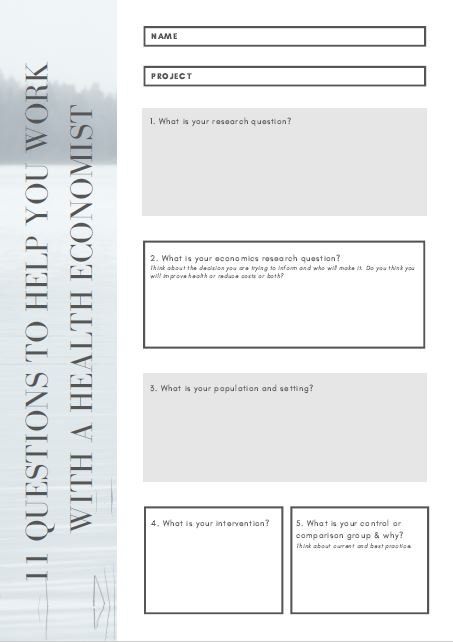
11 questions to help you work with a health economist

As part of developing the ‘Integrating Health Economics In Clinical Research’ Workshop held in Vancouver in Feb 2019, we decided it would be useful to have a session on ‘how to work with a health economist’. This was because many of us had the experience of being contacted at the last minute to ‘add a paragraph about health economics’ to a grant application. This is frustrating because it undervalues the role of health economics, and doesn’t lead to good grant applications or happy health economists.

Many clinicians and researchers are hearing about the benefits of including health economics in their studies, particularly because it is something funders are increasingly looking for. However, many people may not know a lot about health economics, what it can do and what it can offer. This is compounded in many places (including Vancouver and Sydney) by a shortage of health economists and/or limited health economist availability.

By developing a checklist or worksheet we hoped to help people think about their research and how health economics might be part of it. We wanted to recognise that because it is important to talk to a health economist early in the research design process, people might not have all the answers yet, but we were hoping to avoid time wasted trying to squeeze a health economics question into a study that is already designed.

Our initial draft had five or six questions we thought were important, and I decided to run them past the #healtheconomics community on Twitter. I asked “What are the top 3 things you wish clinical people coming to a health economist with a research idea had thought about before your first meeting”. The responses came flooding in, from the serious (‘Where does the clinical uncertainty lie’ and ‘What decision are they trying to inform’) to the hilarious (‘1. What is the comparator, 2. What is the comparator, 3. What is the comparator, precisely’ and ‘1) How long until submission?, followed closely by 2) Are you kidding me?’). Overall there were a couple of key themes. Health economists wanted clinicians to have thought critically about the intervention, comparator and health resource implications of both, but they also wanted them to have started the conversation early enough that there was still scope for the health economics to inform the study design.

So the final product is a crowd-sourced worksheet of 11 Questions to Help You Work With a Health Economist. The questions cover both study design (such as intervention and comparators) and logistics (such as time frame and budget for the project). It has been produced under a Creative Commons with Attribution (CC BY) license, so please feel free to use and share it as you wish. Edited 10th October 2019 to add: If you’d like a more detailed guide to commissioning economic evaluations, you might also find this NSW Ministry of Health guide useful.

11 Questions to Help You Work With a Health Economist

The Integrating Health Economics in Clinical Research Workshop was developed with a team of health economists from British Columbia, Canada including Nick Bansback, Nick Dragojlovic, William Hall, Mark Harrison, Stephanie Harvard, Dean Regier, David Whitehurst and Wei Zhang. 


Cancer deaths to cost Ireland €73 billion over the next 20 years

A paper I worked on at the National Cancer Registry Ireland has been published in the journal BMC Cancer. Together with my collaborators, we estimated that deaths from cancer over the next 20 years will cost the Irish economy €73 billion in lost productivity.

When people die from cancer, society loses their contribution to the economy through paid work, housework, caring for relatives and volunteering. There will be 233,000 deaths from cancer in Ireland between 2011 and 2030. We found that these deaths will result in lost productivity valued at €73 billion; €13 billion in lost paid work and €60 billion in lost unpaid activities. This is almost double the lost productivity from cardiovascular disease in Ireland.

Lung, colorectal and breast cancer were the most expensive cancers overall, because they are the most common. However, when the number of people effected was taken into account, cancers of the testes, cervix and brain were the most expensive because they affect younger people who are often working. We know cancer places a large burden on individual patients and their families. This work shows that there is also a burden for the Irish economy. By estimating how much productivity is lost because of cancer we can inform policy makers and health services about priorities for cancer care and research in the future.

The study found that if Ireland could reduce cancer deaths by 1% per year then the economy would save €8.5 billion over 20 years. The authors suggest that a 1% reduction in cancer deaths could be achieved through improved treatments, reducing smoking rates, and ongoing participation in screening programs for breast, colon, and cervical cancer, as well as the roll out of the HPV vaccine.

The National Cancer Registry Ireland collects data on cancer incidence, treatment and survival in Ireland. They carry out research, such as this work, to help improve cancer outcomes and reduce the cancer burden in Ireland.

Is prostate cancer follow-up by GPs more efficient than hospital based care?

After treatment for prostate cancer, men have ongoing follow-up to monitor for the cancer returning, and to manage any treatment side effects. Traditionally, this follow-up is done by specialist clinicians in the hospital setting, but the growing number of prostate cancer survivors means this is not sustainable.

Evidence suggests that follow-up by a GP, instead of a specialist clinician, doesn’t change how long people survive, how many cancers are identified, or quality of life for cancer survivors. However, the costs of GP-led prostate cancer follow-up have not been investigated in Ireland.

Health economists at the National Cancer Registry Ireland (NCRI) have developed an economic model comparing the health system costs of three strategies for prostate cancer follow-up in Ireland:

  1.  The European Association of Urology (EAU) guidelines, which recommend traditional follow-up by a hospital-based specialist.
  2. The National Institute of Health Care Excellence (NICE) guidelines, which recommend well patients are followed up by GPs after two years.
  3. Current practice in Ireland, based on an NCRI survey.

The results, published in the journal Supportive Care in Cancer, showed that the GP-based follow-up in the NICE guidelines is the most cost efficient strategy for prostate cancer follow-up. Current practice is the least cost efficient strategy because it includes duplication of services within the hospital and primary care. If all the men diagnosed with prostate cancer in Ireland in 2013 were offered follow-up according to the NICE guidelines for the next 10 years, the Irish health care system could save more than €760,000.

Identifying an efficient and sustainable strategy for prostate cancer follow-up care could help to reduce the growing strain on the health care budget. While economic models are simplifications of reality, these results suggest that moving prostate cancer follow-up to primary care should be considered in Ireland to improve efficiency and sustainability.

This work is part of a larger program of research investigating the Challenges of Cancer Survivorship in Ireland funded by the Health Research Board (HRB) and conducted at the National Cancer Registry Ireland in collaboration with national and international researchers.

This news item was originally published on the National Cancer Registry Ireland website: http://www.ncri.ie/news/article/prostate-cancer-follow-gps-more-efficient-hospital-based-care

Research into costs of cancer follow-up wins MASCC conference award

Dr Alison Pearce has won a Young Investigator of the Year Award at the Annual Meeting on Supportive Care in Cancer, hosted by the Multinational Association of Supportive Care in Cancer (MASCC) and the International Society of Oral Oncology (ISOO). The Young Investigator of the Year Awards recognise outstanding young investigators’ research accomplishments.

The award was given for Alison’s work with Ms Fay Ryan, a health economist who completed her Masters project with the National Cancer Registry in 2014. Their project looked at the costs of prostate cancer follow-up care in Ireland as part of the Challenges in Cancer Survivorship project.

Prostate cancer follow-up care is traditionally provided by clinicians in hospital settings. However, growing numbers of prostate cancer survivors mean this may not be economically sustainable and a number of alternative approaches have been suggested. Alison and Fay compared the costs of three alternative strategies for prostate cancer follow-up care in Ireland.

The results indicate that following the UK-based National Institute of Health and Care Excellence (NICE) Guidelines was the most cost efficient follow-up strategy, because NICE recommend follow-up care of well patients be conducted by General Practitioners (GPs) after 2 years, rather than continuing to see hospital-based clinicians. Alison and Fay estimated that the Irish health care system could have saved €760,000 over a 10-year period if the NICE guidelines were adopted in Ireland.

This was the first study investigating the costs of prostate cancer follow-up in the Irish setting, and Alison and Fay’s work was ranked in the top 10 abstracts by junior investigators submitted to the conference, which was held last week in Copenhagen.

This news item was originally published on the National Cancer Registry Ireland website: http://www.ncri.ie/news/article/research-costs-cancer-follow-wins-conference-award

Returning to work after head and neck cancer

A new paper published in the Journal of Cancer Survivorship by researchers at the National Cancer Registry investigates the patterns of return to work in people with head and neck cancer.

The study looked at people diagnosed with head and neck cancer who had been working at the time of diagnosis.  It found that while most people (77%) took some time off work for treatment and recovery, over half of people (58%) eventually did return to work after their diagnosis. The average time taken off work was 9 months, but a small group of people were absent for more than a year before they returned to work. Factors such as the type of cancer, type of treatment and type of work someone had all influenced chances of returning to work after head and neck cancer.

This is the first study to provide estimates of the proportion of people who take time off work following a diagnosis of head and neck cancer and the findings are important for patients, clinicians and employers.

Working contributes to an individual’s sense of self and quality of life, as well as protecting against financial distress, therefore it is important that head and neck cancer survivors are aware that return to work is possible, but may take an extended period of time.

Clinicians need to be aware that patients’ future workforce participation should be considered from the time of diagnosis and may continue to be an issue during and beyond the period of rehabilitation. Policy makers and employers need to be aware that flexibility is required in the workplace to accommodate longer term effects following head and neck cancer, as may be occupational rehabilitation.

This news item was originally published on the National Cancer Registry Ireland website: http://www.ncri.ie/news/article/returning-work-after-head-and-neck-cancer

Article published in The Conversation

Cancer rates are set to double in Ireland by 2040 – here’s why

By Alison Pearce, National Cancer Registry Ireland and Harry Comber, National Cancer Registry Ireland

The latest projections from the National Cancer Registry show that the number of new cancer cases being diagnosed each year in Ireland is expected to double by 2040. To understand such a dramatic rise we need to look a bit more deeply at how the figures are calculated. Three elements determine the projection of trends in cancer incidence: population change, cancer trends, and changes in exposure to risk factors.

Projected numbers of all invasive cancers in Ireland, excluding non-melanoma skin.
NCRI

Population change

An ageing population is the main factor driving an increase in cancer numbers. This is because the rate of ageing is much bigger than any changes in the rate of cancer.

The NCR projections use models of population change provided by the Central Statistics Office. These models make a number of assumptions about mortality, migration and fertility. Only the first of these is likely to have any major impact on future cancer numbers, as the others affect the younger population, where cancer cases are low. With the ageing of the population, and improved life expectancy, the median age of cancer patients at diagnosis will increase.

The projections indicate that almost 50% of people with invasive cancers will be aged over 70. As a result there will not only be more cancer patients, but they will be older on average.

Cancer trends

The projections are also based on the assumption that current trends in cancer incidence will continue. For each cancer, we examined the incidence rates from 1994 to 2010 to find the current trend.

Non-melanoma skin cancer rates, for example, have been increasing since 2001. The projections show that this increase will continue in the future, and skin cancers will in fact be the most rapidly increasing cancers in the future. The primary risk factor for non-melanoma cancer of the skin is UV exposure, and evidence suggests that this steady increase is mainly due to recreational UV exposure, such as sunbeds.

But it doesn’t always follow that what is happening now will predict what will happen in the future. The rapid increase in prostate cancer cases in the 1990s and early 2000s, for example, was due to the widespread use of Prostate Specific Antigen (PSA) testing. This is a blood test which measures the level of the PSA protein in the bloodstream, and was introduced as a way to help with the diagnosis of prostate cancer. But this trend began to level off around 2004, when PSA testing was found to be less useful that previously thought, because many people with raised PSA levels do not have prostate cancer and some prostate cancers identified through testing are very slow growing and may not require treatment. Because of the large variations in trend for prostate cancer in the past two decades, the projections aren’t regarded as very reliable.

Another example of something that can affect cancer rates and therefore projected trends is screening. The introduction of screening for breast and cervical cancers led to a considerable increase in the number of cases that were diagnosed. Screening for colorectal cancer recently begun in Ireland and novel methods of screening for other cancers will probably appear in the next decade. While some screening may eventually bring about a reduction in health service costs, screening will initially increase case numbers and costs above what might be expected from natural increase.

Lifestyle factors

Four risk factors have been shown to determine the majority of the attributable risk of cancer (excluding non-melanoma skin cancer) in the UK: tobacco, diet (including food energy balance, obesity and physical activity), alcohol and reproductive factors. Three of these can be considered lifestyle-related. There are no equivalent calculations for Ireland, but given the similarity in lifestyle between the populations of Ireland and the UK, it is reasonable to assume that the distribution and prevalence of attributable risks due to these major factors are similar.

The link between exposure to these risk factors and cancer incidence can perhaps be most clearly seen with tobacco smoking. Smoking has been implicated as a causal factor in many cancers, and is the cause of the overwhelming majority of lung cancer cases. Smoking prevalence in Ireland is high, although decreasing slowly, and more rapidly in males than females. Overall there has been a fall of about 9% in smoking prevalence for males and of about 8% for females since 1986.

Cigarette smoking preference by gender – 12-month moving average to June 2012.
Office of Tobacco Control, Ireland

The estimated increase in tobacco-related cancers in Ireland and between 2010 and 2040 is 110-115% in females and 83-91% in males. However, given the gradual decrease in female smoking rates in the 1990s, there is likely to be an eventual levelling-off in the number of female lung cancer cases. Men have much higher smoking rates overall, so although it is falling for both genders, it will still take longer for male rates to catch up.

What all this shows is that projections of cancer cases based on existing trends are limited in their ability to predict the future cancer burden. However, the overall conclusions from these projections are clear. Although we cannot modify the effects of demographic change, the majority of cancer risk is due to a small number of well understood and potentially modifiable behaviours: UV exposure, smoking, alcohol consumption, diet and exercise.

The Conversation

Alison Pearce receives funding from the Health Research Board.

Harry Comber does not work for, consult to, own shares in or receive funding from any company or organisation that would benefit from this article, and has no relevant affiliations.

This article was originally published on The Conversation.
Read the original article.